AI News Roundup: The Pentagon Blacklists Anthropic, OpenAI Raises $110B, and Apple Goes All-In on AI Hardware
This was the most consequential week in AI since the technology went mainstream. The U.S. government blacklisted one of the industry’s leading safety-focused companies, OpenAI closed a funding round so large it broke records, Apple announced a full product lineup built around on-device AI, and venture capital numbers for February came in at levels that would have been unthinkable a year ago.
Here’s everything that matters from the week of February 26 - March 4, 2026.
The Big Story: The Pentagon Blacklists Anthropic — and Silicon Valley Picks Sides
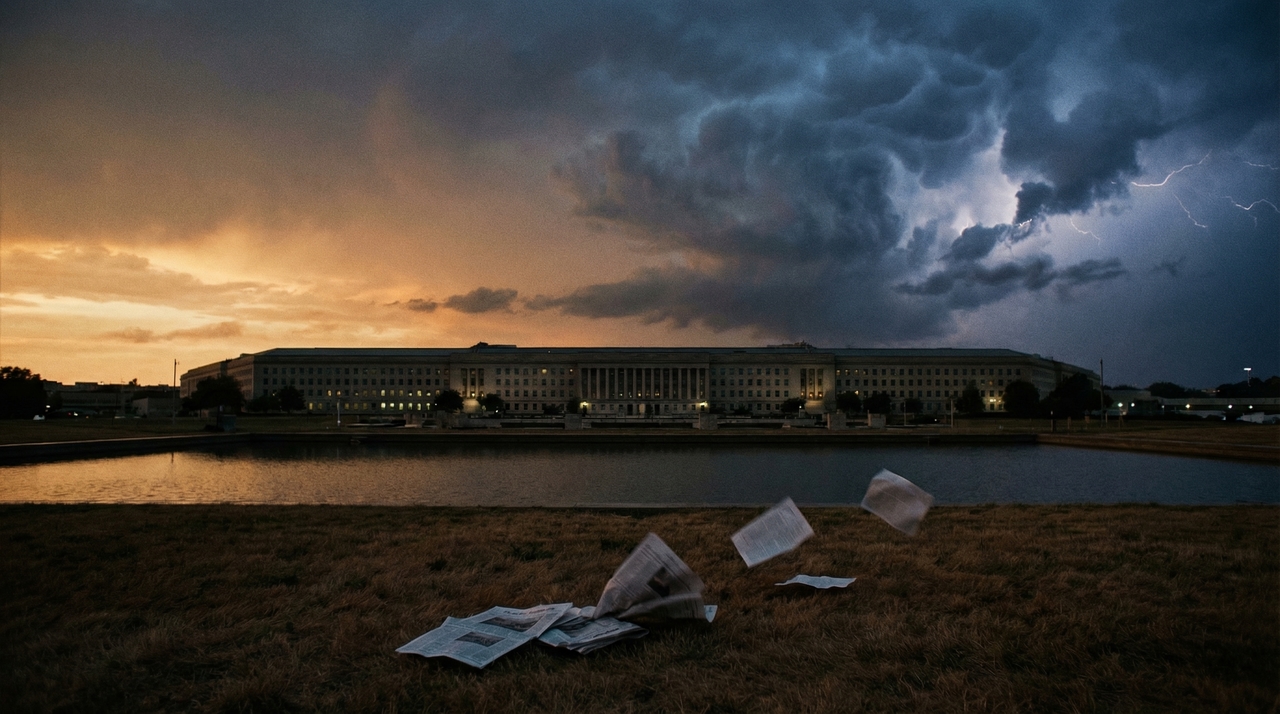
On February 27, Defense Secretary Pete Hegseth designated Anthropic a “supply chain risk” — the first time the U.S. government has ever applied that label to an American company. The move came after Anthropic refused to remove two restrictions from its military AI contract: no mass surveillance of Americans, and no autonomous weapons that fire without human oversight. Trump directed all federal agencies to immediately stop using Claude.
Hours later, OpenAI announced its own Pentagon deal to deploy models on classified networks. CEO Sam Altman admitted the negotiations were “definitely rushed.” Unlike Anthropic, OpenAI agreed to rely on existing law rather than embedding specific prohibitions into the contract. xAI’s Grok was already integrated into classified systems under the Pentagon’s “all lawful use” standard.
The fallout has been swift and dramatic. Anthropic CEO Dario Amodei called the designation “retaliatory and punitive” and announced a legal challenge. Nearly 900 tech workers at Google and OpenAI signed an open letter titled “We Will Not Be Divided” demanding the DOD withdraw the designation. Users boycotted ChatGPT in protest of OpenAI’s deal, pushing Claude to the #1 spot on the App Store. And internal dissent erupted at OpenAI, with employees expressing concern about military applications.
Through it all, Anthropic’s business hasn’t suffered. The company hit nearly $20 billion in annualized revenue — up from $9 billion at the end of 2025 — suggesting the consumer and enterprise market is responding very differently than Washington.
This Week’s Top Stories
OpenAI Closes $110B — The Largest Private Funding Round in History
Amazon invested $50 billion, Nvidia $30 billion, and SoftBank $30 billion, valuing OpenAI at $730 billion pre-money. As part of the deal, AWS becomes the exclusive third-party cloud distribution provider for OpenAI’s enterprise platform, and the existing $38B AWS agreement is being expanded by $100B over eight years. The round remains open with additional investors expected. To put this in context: February’s global VC total hit $189 billion, and three companies — OpenAI, Anthropic, and Waymo — accounted for 83% of it.
Apple Launches Seven Products With AI at the Center
Apple’s March event delivered seven new products, all leaning heavily on AI capabilities. The MacBook Neo ($599, $499 for education) is Apple’s cheapest laptop ever, running an A18 Pro chip with a 16-core Neural Engine. The MacBook Air M5 features a next-gen GPU with a Neural Accelerator in each core. The iPhone 17e ($599) packs an A19 chip and second-gen C1X modem. All seven products ship March 11. Bloomberg separately reported that Apple is readying wearable AI devices as part of a broader push into visual intelligence.
DeepSeek V4 Set to Launch During China’s Two Sessions
China’s DeepSeek is poised to release its V4 model, timed with China’s annual parliamentary meetings. It’s a trillion-parameter Mixture-of-Experts model with approximately 32 billion active parameters, native multimodal capabilities (text, image, and video generation), a 1-million-token context window, and optimization for Huawei Ascend chips — reducing reliance on U.S. semiconductor exports.
Perplexity Launches “Computer” — a 19-Model AI Digital Worker
Perplexity Computer orchestrates 19+ frontier AI models simultaneously to function as a general-purpose digital worker. It can research, design, code, deploy, and manage entire projects end-to-end, dividing work into subtasks handled by specialized sub-agents. Available on the $200/month Perplexity Max tier.
Alibaba’s Qwen3.5 Matches Frontier Performance on Local Hardware
Alibaba released Qwen3.5 models (122B and 35B parameters) that reportedly match Anthropic’s Sonnet 4.5 performance while running on consumer hardware. The 459-point Hacker News thread reflects growing excitement about open-source models reaching frontier capabilities — especially for developers who want to avoid API dependencies.
Quick Hits
- Funding: Ayar Labs raised $500M Series E at $3.75B valuation for silicon-photonic AI chips. Grow Therapy hit $3B valuation with a $150M Series D. Basis became a unicorn at $1.15B for AI accounting.
- Acquisitions: Anthropic acquired Vercept, which built AI agents for full desktop environments, strengthening Claude’s “computer use” capabilities. MyFitnessPal acquired Cal AI, the viral calorie-tracking app built by a 19-year-old with 15M downloads and $30-40M revenue.
- Meta: Signed a $150M content deal with News Corp for AI training data. Created a new Applied AI Engineering org within Reality Labs. Continued embedding Manus AI into Ads Manager.
- Infrastructure: Hyperscalers are planning nearly $700 billion in data center spending for 2026. Blackstone is launching a publicly traded company to buy AI data centers. Akamai deployed NVIDIA Blackwell GPUs for distributed AI inference at 86% lower cost than centralized DCs.
- Healthcare: Quest Diagnostics launched an AI companion using Gemini to analyze 5 years of patient lab data. Qure.ai received FDA clearance for 6 new chest X-ray AI indications. 70% of healthcare orgs now use AI per NVIDIA.
- Research: MIT doubled AI training speed by reclaiming idle GPU time during reinforcement learning. Google’s Gemini Deep Think solved 18 open research problems across mathematics and computer science. Cortex’s 2026 benchmark found AI makes engineering faster but incidents per PR rose 23.5%.
- Policy: AI companies are spending $125M via a super PAC to oppose candidates pushing AI regulation. March 11 federal deadlines loom for Commerce and FTC AI policy statements.
- xAI: Released Grok 4.20 Beta 2 with 65% hallucination reduction and multi-agent architecture.
- Enterprise: Deloitte’s 2026 report finds 89% of companies use AI but only 25% have moved 40%+ of pilots to production. VCs are now cold on “thin wrapper” AI SaaS.
- Google: Absorbed Intrinsic robotics to build the “Android of robotics.” API keys became secrets because of Gemini — the most-upvoted security story of the week on HN with 1,287 points.
- OpenAI: Launched GPT-5.3 Instant, a faster variant of their flagship model.
Hacker News Pulse
The developer community’s week was dominated by the Anthropic/Pentagon saga. Dario Amodei’s statement hit 2,917 points with 1,573 comments — the biggest HN post in weeks. The “How do I cancel my ChatGPT subscription?” help page hit 1,068 points as protest. Gary Marcus’s essay “The whole thing was a scam” drew 987 points.
On the builder side: Andrej Karpathy’s MicroGPT educational implementation hit 1,922 points. An MCP server that reduces Claude context consumption by 98% drew 562 points. Simon Willison published an Agentic Engineering Patterns guide at 356 points. And the question “If AI writes code, should the session be part of the commit?” clearly hit a nerve at 495 points and 389 comments.
AI accountability failures also made waves: Ars Technica fired a reporter over fabricated AI-generated quotes (589 points), and an Indian court erupted after a judge cited fake AI-generated legal orders (355 points).
What This Means
This week drew a hard line through the AI industry. On one side: companies willing to give governments unrestricted access to their models. On the other: a company that said no and got blacklisted for it. The consumer market’s response — Claude hitting #1 on the App Store, 900 tech workers signing protest letters, OpenAI employees pushing back internally — suggests public opinion is more nuanced than Washington expected. The financial numbers tell an even more interesting story: Anthropic’s revenue nearly doubled since December despite losing its entire government business, while February’s $189 billion VC month was almost entirely concentrated in three AI companies. The industry is consolidating fast around a small number of players, the money is staggering, and the question of who gets to set the rules for military AI is now a live political and legal fight that will define the next chapter of this technology.
Ready to automate your busywork?
Carly schedules, researches, and briefs you—so you can focus on what matters.
Get Carly Today →Or try our Free Group Scheduling Tool