Freshservice MCP: Official, but Enterprise-Only Beta
Yes — Freshservice has an official MCP server, but it’s gated twice over. Freshworks ships it as part of the MCP Gateway it announced for Freshservice, and it lets an MCP-compatible AI read and write your tickets, assets, requesters, and service catalog through an endpoint at https://<your-domain>/mcp. The catches worth knowing up front: it’s an Early Access beta limited to the Freshservice Enterprise plan, and you can’t switch it on yourself — you request access through your technical account manager or support@freshservice.com. If that’s not you, a community-built server is the realistic route today.
Either way, the same thing is true about what an MCP server is: it hands your service desk to an AI inside a conversation you start. It’s a doorway, not a worker. Nothing watches Freshservice for you, nothing fires when a P1 lands or an SLA is about to breach, and nothing runs while the chat is closed. Here’s exactly what the Freshservice MCP does, how to turn it on, where it stops — and what to use when you want service desk work that runs on its own.
See also: the full MCP server list — which apps have one, and what each can reach.
What the Freshservice MCP server does
Model Context Protocol (MCP) is the open standard that lets an AI client — Claude, Cursor, Copilot, VS Code, and others — talk to an outside app through a shared interface. Freshworks runs its MCP Gateway in two directions, which is the part most write-ups blur:
- Inbound MCP (
https://<your-domain>/mcp, Early Access beta, Enterprise plan only) — the one people mean by “Freshservice MCP.” It gives an outside AI client 30+ tools across tickets, assets, agents and requesters, onboarding and offboarding, the service catalog, solution articles, and workspaces. It authenticates by API key or OAuth, is restricted to admin and agent users, and during the beta caps usage at roughly 100 tool calls per minute and 5,000 per month. - Outbound MCP (Growth, Pro, and Enterprise, with an active Freddy AI Agent Studio) — the reverse: Freddy AI agents inside Freshservice acting on outside tools like Atlassian, Notion, and Linear. Also early access. It doesn’t help you query Freshservice from Claude.
- Community servers — projects like
effytech/freshservice_mcp(40+ tools, MIT-licensed) call Freshservice’s public API with your domain and API key, and work on any plan.
Whichever you use, once it’s connected an AI client can:
- Look up tickets and assets — “show me the open P1 incidents and which agent owns each” answered from the live service desk.
- Query and filter — “which change requests are still waiting on approval after three days?” run against real data, not a guess.
- Create and update — open an incident, reassign it, bump priority, add a note, or update a requester without leaving the chat.
- Reason across records — summarize this week’s incidents by category, trace a recurring issue across tickets, or draft an update from the conversation thread.
It’s genuinely useful for ad-hoc work: ask a question, get an answer grounded in your service desk, make a change on the spot.
How to set up the Freshservice MCP server
If your account is on Enterprise and you’ve been let into the Early Access Program, the official path is short:
- Request access first — the EAP isn’t self-serve. Contact your technical account manager or email
support@freshservice.com. - Get your Freshservice API key from your profile settings, or use OAuth if your client supports it. You need admin or agent privileges.
- In your AI client’s connector settings, add a remote MCP server pointing at
https://<your-domain>/mcp. In Claude that’s Customize → Connectors → Add custom connector; Freshworks also documents Claude Code, Claude Desktop, Cursor, Microsoft Copilot Studio, and VS Code. - Confirm the tools appear, then start a chat and ask it to read or update a ticket.
If you’re not on Enterprise (or not in the EAP), a community server is the realistic route: install one like effytech/freshservice_mcp, set your Freshservice domain and API key as environment variables, add it to your client’s MCP config, and restart. Freshworks’ own docs cover the official flow; the community projects document theirs on GitHub.
Where the Freshservice MCP stops
None of this is a knock on MCP — it’s just the shape of the protocol. Four limits show up the moment you want more than a conversation:
- It only works inside a chat you start. Close the window and nothing happens. The AI doesn’t watch Freshservice; it waits for you to ask.
- No triggers. A P1 incident landing, a change request sitting unapproved, an SLA about to breach, an asset going unassigned — none of these can start anything through MCP. There’s no “when this happens in Freshservice, do that.”
- It’s one app at a time. The Freshservice MCP knows Freshservice. Getting an incident into a Slack channel, a linked issue into Jira, and a row into a reporting sheet means wiring up (and authing) a separate MCP server for each, then hoping your client can juggle them in one turn.
- You own the plumbing and the scopes. API keys, the beta’s rate caps, and the blast radius of read/write access across your tickets and asset records are on you — and on a community server, there’s no vendor support line behind it.
So the Freshservice MCP is a great way to ask your service desk things and make one-off edits. It is not a way to make Freshservice run — to have work happen on a schedule or in reaction to an event, across the other tools a ticket touches.
Running Freshservice work that doesn’t need a chat open
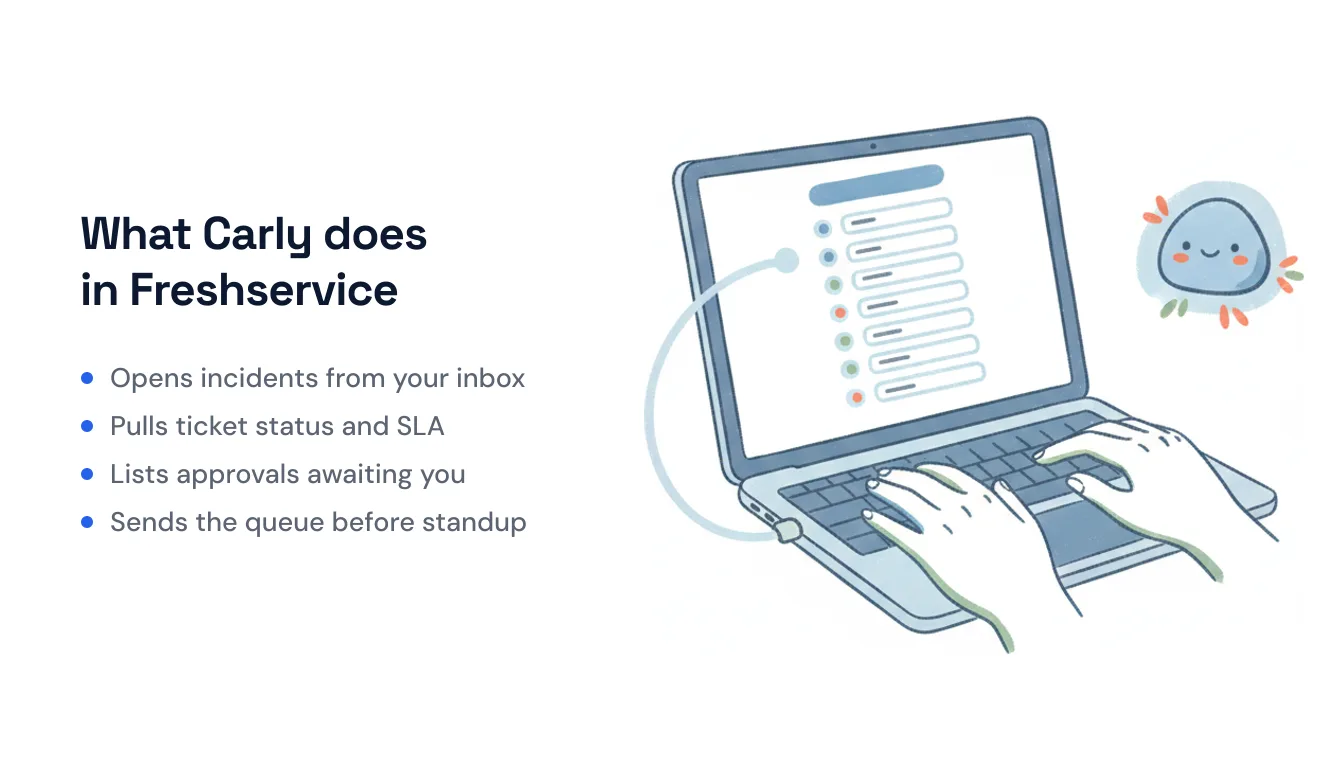
That “run on its own, across apps” gap is exactly where Carly fits. Carly connects to Freshservice natively — no Enterprise gate, no EAP waitlist, no server to host or API key plumbing to maintain — and to the ~260 other apps it supports natively, plus anything with a public API through your own key. The difference from MCP is the important part: Carly’s workflows are triggered and scheduled, so Freshservice work happens whether or not anyone has a chat window open.
A few things that MCP can’t do but a Carly workflow can:
- When a P1 incident comes in → post it to the
#it-incidentsSlack channel, open a linked Jira issue, and text the on-call lead — the moment it arrives. - Every morning → summarize open incidents by priority and the change requests still awaiting approval, and send the breakdown to the service desk lead before standup.
- When a ticket has gone quiet past its SLA window → log it to a Google Sheet and email the assigned agent a nudge with the ticket history.
The non-AI steps — the moving, matching, and routing between apps — are free, the Zapier-style backbone of the workflow. The AI steps (drafting, summarizing, deciding) start at $35/month. You describe the outcome in plain language and Carly wires up the Freshservice connection and everything downstream.
If you just want to interrogate your service desk from a chat and you’re on Enterprise with EAP access, Freshservice’s official MCP server is the right tool. If you want Freshservice to actually do things — on a trigger, on a schedule, across every app an incident flows through — that’s the job MCP wasn’t built for, and it’s the one Carly was.
FAQ
Does Freshservice have an official MCP server?
Yes, but it’s gated. Freshworks ships an official inbound MCP server at https://<your-domain>/mcp as part of its MCP Gateway. It’s currently an Early Access beta limited to the Freshservice Enterprise plan, it isn’t self-serve — you request access through your technical account manager or support@freshservice.com — and it’s open to admin and agent users only. On other plans, community servers like effytech/freshservice_mcp are the realistic option.
Is the Freshservice MCP server free, and are there limits? There’s no separate charge during early access, but it requires an Enterprise plan and caps usage at about 100 tool calls per minute and 5,000 per month, with Freshworks noting those limits may change and may eventually be charged for. Community servers work on any plan but run against your normal Freshservice API key and its rate limits, and you host and maintain them yourself.
What’s the difference between inbound and outbound MCP in Freshservice? Inbound MCP lets outside AI clients like Claude or Cursor query and update your Freshservice data — that’s Enterprise-only early access. Outbound MCP is the reverse: Freddy AI agents inside Freshservice acting on external tools like Atlassian, Notion, and Linear. Outbound is available on Growth, Pro, and Enterprise but requires an active Freddy AI Agent Studio, and it won’t help you reach Freshservice from a chat client.
Can the Freshservice MCP trigger automations? No. MCP is request/response inside an AI chat — it has no triggers and nothing runs when the conversation is closed. For event- or schedule-driven Freshservice work across apps, you need a workflow tool like Carly rather than an MCP server.
Can I connect Freshservice to AI without coding or hosting a server? Yes. You don’t have to be on Enterprise, wait for an EAP invite, host a community server, or touch MCP at all. Carly connects to Freshservice for you and lets you build the automation in plain language — describe what you want to happen and it wires up the service desk and the other apps involved, with no server to host and no code to write.
Ready to automate your busywork?
Carly schedules, researches, and briefs you—so you can focus on what matters.
See what people say
"Before Carly, I relied on a Calendly link, but the whole process felt impersonal and not very professional. Carly changed that by handling all the back-and-forth, so I'm no longer stuck in endless email threads trying to line up schedules.
Now Carly reaches out to candidates, shares my real-time availability, lets them pick a slot, then sends a Zoom link and drops it straight into my calendar. She sends reminders to both of us before each call, which has significantly reduced no-shows and last-minute confusion.
On top of scheduling, Carly acts like a full executive assistant, sending me my schedule the night before so I can prepare for each call. It reminds me of the old x.ai assistant, but Carly is noticeably smarter, faster, and better suited to my healthcare recruitment business."