The Best AI Agent for Business (2026)
Search “AI agent for business” and you’ll get three genuinely different kinds of product dressed in the same language. Knowing which is which is most of the buying decision.
Chat assistants — ChatGPT, Microsoft Copilot, Google Gemini — are brilliant at answering questions, drafting, and summarizing. But by default they advise; they sit in a chat window and wait for you to ask. They don’t watch your inbox and act on it.
Workflow builders — Zapier Agents, Make, n8n, Relevance AI — let you construct automations that fire across your apps. They’re powerful and flexible, but you build and maintain them on a canvas, and they reward technical patience.
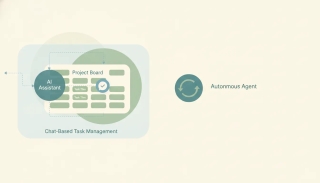
Action assistants — Carly and Lindy — sit between the two. You delegate a job in plain English and the agent does it across your business apps: reads the email, books the meeting, updates the CRM, sends the follow-up. No prompt babysitting, no flow diagram to maintain.
Most businesses think they want the first kind, discover they need the third, and only reach for the second when they have a specific pipeline to engineer. This guide sorts the field by what each actually does, so you buy for the outcome you want rather than the label.
Higher on this axis means the tool takes the task off your plate rather than helping you do it faster. That’s the distinction that matters once you’re past experimenting — a chatbot saves you minutes; an agent that acts gives you back the task entirely.
What “AI Agent for Business” Should Actually Mean
An agent, as opposed to a chatbot, does three things a chat window doesn’t:
- It’s triggered by events, not just by you asking. A real agent can watch an inbox, a calendar, or an app and act when something happens — an email arrives, a deal moves, a form is submitted — without you sitting there prompting it.
- It takes actions across your tools. Not “here’s a draft you could send,” but sends it; not “you could log this,” but logs it — reaching into your CRM, calendar, help desk, and docs.
- It holds context and rules over time. It remembers how you like things done and applies the same judgment consistently, so you’re not re-explaining every time.
Judge any “AI agent for business” against those three. A tool that only answers when asked is a very good assistant in the old sense — useful, but not an agent.
How We Evaluated
Does it act or advise? The core split. Does the tool take work off your plate, or help you do it faster?
How much setup does it need? Some agents are usable in fifteen minutes; some are a build project. Neither is wrong — but you should know which you’re buying.
Where does it live? In your inbox, in your Office suite, on its own canvas, in a chat tab. This determines whether you’ll actually use it.
How broad is its reach? How many of your business apps can it actually touch and take action in?
How is it priced? Flat seat pricing, per-task credits, or per-outcome — each has a break-even point at a different scale.
1. Carly AI
Carly AI is an action assistant you delegate to by email or text. There’s no dashboard to log into — you reach it the way you’d reach a capable assistant, by sending a message, and it does the work and replies. That single design choice is why businesses actually keep using it: it lives in the inbox you already check, so it never becomes another tab you forget.
You set it up by building named AI agents, each with a name, its own email address, plain-English instructions, and memory. One agent handles your inbox triage. Another books meetings and manages your calendar. Another watches for new leads and logs them to your CRM with a first follow-up drafted. You describe the job in ordinary language; Carly runs it and learns your preferences over time. Agents can be event-triggered — fire when an email lands, when a deal changes, when something happens in a connected app — which is what makes them agents rather than a chat box.
Its reach is the widest practical part: 200+ integrations across CRM, email, calendar, project management, accounting, support, and more — HubSpot, Salesforce, Notion, Slack, Stripe, QuickBooks, Google Workspace, and Microsoft 365 among them. For anything without a native connector, you can paste your own API key on the dashboard and Carly reaches it that way.
Best for: Business owners and teams who want to delegate real work — email, scheduling, CRM, follow-up, cross-app tasks — to an agent that acts, without maintaining a separate tool or a flow builder.
Key features:
- Email-and-text native — no app to install, no console to live in
- Named, event-triggered agents with plain-English instructions and memory
- 200+ integrations, plus bring-your-own-API-key for anything else
- Drafts and acts in your voice; improves over time
- Works in Gmail and Outlook/Microsoft 365
Pricing: From $35/month for AI agents. Non-AI workflow steps aren’t metered.
Limitations: Carly is a delegation-first assistant, not a visual workflow canvas — if you want to draw a complex branching pipeline with conditional logic across a dozen systems, a builder like Zapier or n8n gives you more granular control. And it’s a working assistant, not a research chatbot; for open-ended brainstorming, pair it with ChatGPT or Claude.
Why it stands out: Most “AI agents for business” either wait in a chat window or make you build the automation yourself. Carly takes a plain-English instruction and does the job across your apps, from the inbox you already use.
2. Lindy
Lindy is the closest conceptual match to Carly — an AI assistant you can reach by text that manages email, calendar, meetings, and follow-ups, with persistent memory and deep SaaS integrations. It’s genuinely capable at the communications-and-scheduling layer, and its agent-building is flexible.
The main practical difference is where it lives and how it’s priced. Lindy is app- and dashboard-centric, and it meters usage in credits: every action costs credits, and complex, multi-step runs burn more. Plans run from a starter credit allowance through Plus at around $29.99/month up to higher business tiers, with no permanent free plan. We wrote a full breakdown in our Lindy AI pricing guide.
Best for: Teams that want a flexible, buildable AI assistant for email, scheduling, and meetings and are comfortable managing a credit-metered usage model.
Key features:
- Text-reachable assistant for email, calendar, and follow-ups
- Persistent memory and flexible agent building
- Deep SaaS integrations
- Meeting and scheduling automation
Limitations: Credit metering means cost scales with how much the agent does — heavy use can get expensive, and you have to watch the meter. More dashboard-centric than inbox-native.
3. Zapier Agents
Zapier brings AI agents to the automation platform that already connects 7,000+ apps — by far the broadest connectivity in the category. Zapier Agents let you build agents that trigger on events across your stack and take actions through Zapier’s enormous integration library.
If your business already runs on Zapier and you want AI decision-making layered onto flows you understand, this is the natural extension.
Best for: Teams already invested in Zapier who want AI agents riding on the widest app connectivity available.
Key features:
- 7,000+ app integrations — the broadest in the market
- AI agents that trigger on events and take multi-step actions
- Sits on top of Zapier’s mature automation platform
- Granular control over triggers and steps
Limitations: It’s a builder — you construct and maintain the automations, which is powerful but takes time and a certain comfort with the tooling. Task-based pricing can climb with volume. Less “delegate in plain English,” more “engineer the flow.”
4. Microsoft 365 Copilot
Microsoft 365 Copilot is the strongest choice for businesses that live inside Word, Excel, Outlook, and Teams. It brings AI directly into the Office apps your team already uses, and with Copilot Studio you can build custom agents grounded in your company’s data.
Copilot for Microsoft 365 is priced around $30/user/month (business SKUs run lower, in the ~$18–21/user/month range on current promotional pricing). For an all-Microsoft shop, the in-context value is real: AI right where the work already happens.
Best for: Businesses standardized on Microsoft 365 that want AI embedded in their existing Office apps.
Key features:
- Native AI across Word, Excel, Outlook, PowerPoint, and Teams
- Copilot Studio for building custom agents on company data
- Grounded in your Microsoft Graph (files, email, calendar)
- Enterprise security and compliance
Limitations: Most valuable inside the Microsoft ecosystem — the payoff shrinks if your business runs on Google or a mixed stack. By default it’s more assistant-in-context than autonomous cross-app agent; the agent-building (Copilot Studio) is a separate effort.
5. Google Gemini for Workspace
Google Gemini is the Microsoft Copilot equivalent for Google Workspace shops — AI built into Gmail, Docs, Sheets, and Meet. Google has folded Gemini directly into Workspace plans rather than selling it as a separate add-on, so for Workspace businesses it’s increasingly just there.
Best for: Businesses running on Google Workspace that want AI native to Gmail, Docs, and Sheets.
Key features:
- AI native across Gmail, Docs, Sheets, Slides, and Meet
- Bundled into Workspace plans
- Grounded in your Google Workspace data
- Strong document and summarization features
Limitations: Like Copilot, its value is highest inside its own ecosystem and thinner across a mixed stack. Oriented toward in-app assistance rather than autonomous, event-triggered action across third-party business tools.
6. Relevance AI and n8n
Relevance AI and n8n sit at the builder end for teams that want to engineer their own agents. Relevance AI is designed for organizations building teams of specialized agents that hand work to each other; n8n is a developer-friendly, self-hostable workflow automation tool with strong AI-agent nodes and full control over data and logic.
Best for: Technical teams that want to build and own custom multi-agent systems — and, with n8n, self-host for data control.
Key features:
- Build teams of specialized, collaborating agents (Relevance AI)
- Self-hostable, developer-friendly workflow control (n8n)
- Deep customization of logic and integrations
- Full ownership of data and deployment (n8n)
Limitations: These reward engineering time — they’re the most powerful and the least turnkey. Wrong choice if you want to delegate a task in plain English today; right choice if you’re building a durable, custom agent system.
7. ChatGPT (Chat and Agent Mode)
ChatGPT is the default AI assistant for a reason — the best generalist for drafting, analysis, research, and problem-solving, now with an agent mode that can browse and take some actions on your behalf. For most businesses it’s the everyday thinking tool that sits alongside whatever action agent runs the workflows.
Best for: Every business, as the general-purpose reasoning and drafting assistant — used alongside, not instead of, an action agent.
Key features:
- Best-in-class general reasoning, drafting, and analysis
- Agent mode for browsing and limited task execution
- Huge ecosystem of custom GPTs and connectors
- Familiar, low-friction interface
Limitations: By default it’s a chat window — it waits for you and doesn’t natively watch your inbox or run event-triggered workflows across your business apps. It’s the advisor, not the operator; most businesses use it with a separate agent that actually acts.
How to Pick the Right AI Agent for Business
If you want to delegate real work and get the task off your plate — email, scheduling, CRM, follow-up, cross-app jobs — Carly does it from the inbox you already use, at $35/month, with 200+ integrations and no flow builder to maintain. See how to create a custom AI email agent to start.
If you want a flexible buildable assistant and don’t mind a usage meter, Lindy covers similar ground with a credit model. If your business already runs on Zapier, Zapier Agents layer AI onto the broadest app connectivity there is.
If you’re an all-Microsoft or all-Google shop, Copilot or Gemini put AI right inside the apps you already live in — the lowest-friction choice within one ecosystem. If you have engineering time and want to own a custom multi-agent system, Relevance AI or n8n give you the most control.
And keep ChatGPT as the general reasoning tool alongside whichever agent runs your workflows. The mistake to avoid is buying a chatbot when you needed an operator — or a flow builder when you just wanted to hand off the task.
Quick Comparison: AI Agents for Business
| Tool | Category | Where It Lives | Acts or Advises? | Price |
|---|---|---|---|---|
| Carly AI | Action assistant | Your inbox / text | Acts (delegate in plain English) | From $35/mo |
| Lindy | Action assistant | App + text | Acts (credit-metered) | From ~$29.99/mo; no free tier |
| Zapier Agents | Builder | Zapier platform | Acts (you build the flow) | Task-based |
| Microsoft Copilot | In-app assistant | Office / M365 | Advises + agents via Studio | ~$30/user/mo |
| Google Gemini | In-app assistant | Google Workspace | Advises (in-app) | Bundled in Workspace |
| Relevance AI / n8n | Builder | Own canvas / self-host | Acts (you engineer it) | Varies / self-host |
| ChatGPT | Chat assistant | Chat window | Advises + limited agent mode | From ~$20/mo |
FAQ
What is an AI agent for business?
An AI agent for business is software that takes work off your plate by acting across your business tools, rather than just answering questions. A true agent can be triggered by events (an email arriving, a deal moving), take actions in your apps (send the reply, book the meeting, update the CRM), and apply consistent rules over time. This is distinct from a chatbot like ChatGPT that waits for you to ask, and from a workflow builder like Zapier that you configure by hand.
What’s the best AI agent for a small business?
For most small businesses, Carly AI at $35/month is the most direct fit — you delegate email, scheduling, CRM logging, and follow-up in plain English, and it acts across 200+ integrations from the inbox you already use, with no dashboard or flow builder to maintain. If you’re an all-Microsoft or all-Google shop, Copilot or Gemini are the lowest-friction in-app options; if you already run on Zapier, Zapier Agents extend it with AI.
What’s the difference between an AI agent and a chatbot?
A chatbot answers when you ask it — it lives in a chat window and waits for a prompt. An AI agent is triggered by events, takes actions across your tools, and holds rules and context over time. ChatGPT, Copilot, and Gemini are primarily chat assistants (with growing agent features); Carly and Lindy are action assistants built to do the work; Zapier and n8n are builders you configure to run automations. Many businesses use a chatbot for thinking and an agent for doing.
How much does an AI agent for business cost?
It varies by model. Flat subscription tools like Carly are $35/month regardless of how much the agent does (non-AI workflow steps aren’t metered). Credit-metered tools like Lindy start around $29.99/month and cost more as usage climbs. Microsoft Copilot is around $30/user/month; Google Gemini is bundled into Workspace plans; Zapier Agents are task-priced. The cheapest model depends on your volume — a fixed monthly subscription wins for heavy use, per-task can win for light use.
Can an AI agent connect to my existing business tools?
Yes — connectivity is the whole point. Carly has 200+ native integrations (HubSpot, Salesforce, Notion, Slack, Stripe, QuickBooks, Google Workspace, Microsoft 365, and more), plus a bring-your-own-API-key option for anything without a native connector. Zapier connects to 7,000+ apps. Copilot and Gemini are strongest inside their own ecosystems (Microsoft 365 and Google Workspace respectively). Check that a tool reaches the specific apps you run before committing.
For more on choosing and setting up business AI, see our guides to the best AI tools for small business owners, the best AI workflow automation tools, and the complete list of AI assistants for 2026.
Ready to automate your busywork?
Carly schedules, researches, and briefs you—so you can focus on what matters.
See what people say
"Before Carly, I relied on a Calendly link, but the whole process felt impersonal and not very professional. Carly changed that by handling all the back-and-forth, so I'm no longer stuck in endless email threads trying to line up schedules.
Now Carly reaches out to candidates, shares my real-time availability, lets them pick a slot, then sends a Zoom link and drops it straight into my calendar. She sends reminders to both of us before each call, which has significantly reduced no-shows and last-minute confusion.
On top of scheduling, Carly acts like a full executive assistant, sending me my schedule the night before so I can prepare for each call. It reminds me of the old x.ai assistant, but Carly is noticeably smarter, faster, and better suited to my healthcare recruitment business."