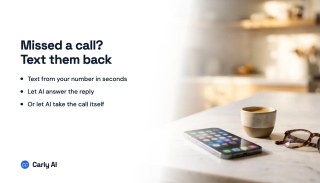
Business Texting: How to Text Customers the Right Way
Plenty of your customers would rather text than call. Most businesses still answer those texts from someone’s personal cell, or not at all.
Business texting fixes that if you set it up in the right order: the number, the carrier paperwork, the consent rules, then the team and the AI.
The quick answer: Business texting means two-way text conversations with customers from a business number instead of a personal cell. Pick a number (local, toll-free, or the one you already have), register it with the carriers (A2P 10DLC for local numbers, toll-free verification for toll-free), honor STOP and quiet hours, and give your team a shared inbox so no text sits unanswered. For a team, the pick is Carly: texts, calls and email land in one inbox, Carly answers inbound texts from your own information, qualifies and books the customer, and any teammate can take over a thread.
Business texting tools compared
US list prices from each vendor’s own pricing page, checked October 1, 2026, on monthly billing where there’s a toggle.
| Tool | Best for | Price | Priced per | AI on inbound texts |
|---|---|---|---|---|
| Carly | Teams that want texts, calls and email in one inbox | Number and texting set on a short call. Free Zapier-style workflows; AI agents from $35/month | Team | Answers, qualifies and books; a teammate can take over any thread |
| Quo (formerly OpenPhone) | Small teams sharing a number for calls and texts | $19/user/mo ($15 billed annually), plus $19.50 one-time carrier review and $1.50 to $3/mo | User | Suggested replies, plus Sona lead capture (beta) that qualifies new leads by text, then hands off |
| Podium | Local businesses that also want reviews and payments | Core $399/mo, Pro $599/mo, plus $5/mo 10DLC fee per US location | Location | AI Employee add-on |
| Heymarket | Support and sales teams on shared text inboxes | $24/user/mo (2-user minimum), plus credits at $0.03 and $10/mo per 10DLC campaign | User, plus credits | AI agents for Q&A and scheduling, in beta on Plus and up |
| Textline | Support teams that only need texting | Not published; extra credits $0.03, $15/mo 10DLC campaign fee | Plan, agents and credits | Automations and automatic responses |
| SimpleTexting | Text campaigns with replies on the side | $29/mo for 500 credits, plus $10/mo local number and $4 activation; 3 users included | Account | AI Assist drafts messages |
| EZ Texting | Text marketing lists | $25/mo for 500 credits ($20 billed annually), plus $5/mo telecom fee; 1 user included | Account | AI Reply and AI Compose draft messages |
| Google Voice | One-to-one texts from a Workspace number | $10/user/mo Starter (up to 10 users), $20 Standard, $30 Premier, plus a Workspace plan | User | None for texts; its policy bars automated texts |
Per-user tools get expensive as the team grows; per-account tools charge by the text. SimpleTexting and EZ Texting are built for campaigns, the rest for answering customers.
This guide is about conversations with one customer at a time (“Can you come Thursday?”), not SMS marketing blasts to a list, which carry a higher consent bar (step 3).
Step 1: Pick the number customers will text
| Number | Good for | Carrier paperwork |
|---|---|---|
| New local number | Service businesses with nearby customers | A2P 10DLC brand and campaign registration |
| Toll-free number | Businesses serving a region or the whole country | Toll-free verification |
| Your existing number, text-enabled | Keeping the number on your van, invoices and Google profile | Same as its type (a landline registers as 10DLC) |
The existing number is usually right: customers already text it, and if it’s a landline that isn’t text-enabled, those texts go nowhere today. Most providers can text-enable a landline or VoIP number without moving your calls (a cell number moved to a texting-only provider can lose voice calling). Carly will set up your business number with you, new or existing.
Step 2: Register with the carriers before you send
US carriers filter business texts from unregistered numbers.
Local numbers: A2P 10DLC. You register a brand (your business, checked against your EIN) and a campaign (what you’ll text about, sample messages, how customers opt in) with The Campaign Registry. Per Twilio’s A2P 10DLC fee breakdown:
- Brand: $4.50 one-time for a sole proprietor or low-volume standard brand, or $46 one-time for a standard brand.
- Campaign: $15 one-time vetting, then $1.50 a month for low-volume mixed use, $2 for sole proprietors or $10 for standard use cases.
Timing is the trap: Twilio’s onboarding guide puts manual brand review at seven business days or more and campaign vetting at two to three weeks.
Toll-free numbers: toll-free verification. One form: business details, use case, sample messages and proof of opt-in. Twilio says it reviews requests within three business days. Since February 17, 2026, new submissions need a business registration number (an EIN in the US) unless you’re a sole proprietor.
Reviewers check that your website matches your business name and shows how customers opt in, so fix both before you file. On Carly, carrier registration is part of setup.
Step 3: Get consent, honor STOP and respect quiet hours
The Telephone Consumer Protection Act (TCPA) sets the floor, and damages run $500 per unlawful text, up to $1,500 if willful.
- Consent. Replying to a customer who texted you first is a conversation they started. Marketing texts need prior express written consent, such as a checked box on a form that says they’ll get texts. Keep a record of how each person opted in.
- STOP means stop. Under the FCC’s revocation rules, in force since April 11, 2025, customers can opt out any reasonable way, and “stop,” “quit,” “end,” “revoke,” “opt out,” “cancel” or “unsubscribe” always count. Honor it within 10 business days. You may send one non-promotional confirmation, ideally within five minutes.
- Quiet hours. Federal rules bar telephone solicitations before 8am or after 9pm in the customer’s time zone, and Florida’s telemarketing law cuts off at 8pm. Answering a customer who just texted you at 9:30pm isn’t a solicitation, but follow-ups you start should wait until morning.
Carly honors STOP opt-outs, and scheduled texts move the 10pm follow-up to 9am.
Step 4: Text as a team, not from one person’s phone
Once a second person answers texts, a personal phone stops working. A team needs:
- A shared inbox: every text to the business number in one place, one thread per customer, history attached.
- Assignment: each conversation has an owner, so two people don’t both reply and nobody assumes someone else did.
- Internal notes: teammates discuss a thread (“@Megan, is Thursday open?”) without the customer seeing it.
- Rules for who replies: new leads to whoever quotes, scheduling to the office, complaints to the owner, routed on arrival.
Google Voice handles one-to-one texts well, but sharing one number’s texts across a team is where admins get stuck (Google Voice for business has the details). For the email side, see best shared inbox tools.
Step 5: Let AI answer the texts nobody gets to
Texts arrive when nobody’s free: the plumber is under a sink, everybody’s asleep. A good AI texting agent answers the question from your own information, qualifies the customer with your questions and books a real calendar slot, then confirms by text. The moment a teammate replies by hand, it steps back.
Be wary of “AI” that only suggests replies a person still has to send: it saves typing, not response time. AI text messaging goes deeper, and SMS appointment booking covers the booking side.
How Carly runs business texting for a team
Carly gives your team a business number for calls and texts, new or the one you already have, and one inbox where email, texts and calls share a timeline per customer. The Carly team sets up the number with you, carrier registration included.
Here’s a Tuesday at Whitaker Plumbing, a four-person shop run by Josh:
- 8:40pm. Claire texts the business number: “Water heater is leaking, can someone come tomorrow?”
- Carly replies right away from the shop’s knowledge files: they cover her area, here’s the diagnostic fee, here’s how to shut off the water tonight.
- It qualifies her with Josh’s questions: tank or tankless, how bad the leak is, the address.
- It books her into the 9am slot on Ryan’s calendar and confirms by text from the business number.
- It logs everything on Claire’s record in Carly’s CRM, which also writes back to HubSpot, Salesforce or Dynamics 365.
- 7:30am. Emily in the office opens the thread, leaves an internal note for Ryan and texts Claire herself about parking. Her reply pauses the AI on that conversation.
The rest of the setup:
- One team inbox. Assign any conversation, leave internal comments and @mention teammates. Your team can call and text from the browser.
- Control over the AI. For each agent, choose whether it sends replies, drafts them for review or doesn’t reply. AI answering can be switched off per number.
- Lead routing. Rules send each new lead to the right teammate based on what the lead arrives with, and booking pages round-robin across the team.
- Workflows in plain English. Workflows trigger on text received, call ended or voicemail received. Write “when a call is missed, text the caller back from the business number” once and it runs on every missed call (missed call text back walks through it).
- Calls and email on the same timeline. If Claire calls instead, Carly’s AI receptionist answers when nobody picks up. Support email can go to its own email agent.
- The rest of your stack. Carly connects to thousands of apps.
This tutorial shows how to automatically text leads and book appointments. Get started with Carly, or book a short call to see it on your own number.
The other business texting tools
Quo (formerly OpenPhone). Shared numbers, internal threads, snippets and scheduled texts. Its Sona agent answers calls, and a beta Sona for text qualifies brand-new leads before handing them to your team; other texts get suggested replies. Shared numbers on Starter are capped at 10 paid users. See Quo alternatives.
Podium. Texting bundled with reviews, webchat, payments and phones, from $399 a month on Core. Plans carry usage limits (1,500 AI messaging segments a month, for example), with overages on top.
Heymarket. A texting-first shared inbox with templates, tags and HubSpot on every plan. Plus is $49 and Pro $75 per user/month.
Textline. Texting only; HIPAA plans cost extra. Essentials includes three agents and 600 message credits a month. Its numbers don’t place calls; they can only forward them.
SimpleTexting. Mass texting with two-way replies included. Toll-free numbers cost nothing extra but can take up to a week to approve. Extra users are $20/month each.
EZ Texting. Text marketing (keywords, sign-up forms, drip campaigns) with a team inbox on the side. Extra seats are $10/month.
Google Voice. Calls and one-to-one texts per Workspace user, US only. Its acceptable use policy bars bulk messages and anything sent by a script, so automated reminders are out.
FAQ
What is business texting?
Two-way text messaging between a business and its customers from a business number, through an app the whole team can use. Carly puts those texts in one inbox with your calls and email, and answers them when your team is busy.
Can I text customers from my existing business number?
Usually. Most providers can text-enable a landline or VoIP number without moving your calls, and it still needs carrier registration. Carly can set up the number you already have.
How long does A2P 10DLC registration take?
Plan on two to four weeks: Twilio puts brand review at seven business days or more and campaign vetting at two to three weeks. Toll-free verification is quicker, with reviews within three business days.
How much does business texting cost?
A software fee plus carrier fees. Quo starts at $19 per user/month and SimpleTexting at $29/month for 500 texts. 10DLC registration adds $4.50 to $46 for the brand, $15 for the campaign and $1.50 to $10 a month. Carly’s number and texting are priced on a short call; Carly has free Zapier-style workflows, with AI agents from $35/month.
Can AI answer business texts?
Yes. An AI texting agent can answer questions from your information, qualify the customer and book a time, with a person taking over whenever they want. On Carly, a teammate replying by hand pauses the AI on that conversation.
Ready to automate your busywork?
Carly schedules, researches, and briefs you—so you can focus on what matters.
See the prompt
Set up Carly for me. Carly connects to thousands of apps, from Gmail, Outlook and my calendars to Slack, HubSpot and QuickBooks, and keeps working after this chat is closed: answering email, booking meetings, following up and running workflows the moment something happens.

1. Add the Carly MCP server (https://carlyassistant.com/mcp/) and sign me in. Use the one that matches you:
   - Claude Code: claude mcp add --transport http --scope user carly https://carlyassistant.com/mcp/  (then I run /mcp, pick carly, and authenticate)
   - Codex: codex mcp add carly --url https://carlyassistant.com/mcp/  then  codex mcp login carly
   - Claude (claude.ai, Claude Desktop, or Cowork): Customize > Connectors > Add custom connector, paste the URL, and sign in. Carly is also in Claude's connector directory at claude.ai/directory/carly.
   - ChatGPT: open Plugins, search for "Carly" and add it (or click + and paste the URL), then sign in.
   - Cursor: add {"mcpServers": {"carly": {"url": "https://carlyassistant.com/mcp/"}}} to ~/.cursor/mcp.json, then sign in to carly from Customize.
   - Muse: I will create a Carly API key at carlyassistant.com/integrations (Advanced > API Keys > Create a new key, with Select all scopes). Build a custom connector to https://carlyassistant.com/mcp/ using an API key as a bearer token, and ask me for the key in your secure credential prompt.
   - Grok: go to grok.com/connectors, choose New Connector, then Custom, paste the URL, and sign in.
   - Grok Bot: open Plugins, add a custom remote MCP server named carly with the URL, then I approve it and sign in.
   - Perplexity: Settings > Connectors > Custom connector > Remote, paste the URL, and sign in.
   - Anything else: add a remote MCP server (streamable HTTP) named carly with the URL. It signs in with OAuth.
   I sign in with my Carly account, or create one at carlyassistant.com.

2. Walk me through connecting my accounts at https://carlyassistant.com/integrations. Under Accounts, I type each email address I use and click Add Email. On each new address, I click Connect Gmail or Connect Outlook, tick what Carly can reach (Email, Calendar, Contacts, Drive or OneDrive), then click Connect with Google or Connect with Microsoft and grant access. For an address that is already connected, I open Manage access and click Connect next to anything missing. Repeat for every address. Then ask which of my other apps I want connected too.

3. Check it worked: list my connected mailboxes and calendars and tell me every account you can see.

4. Then ask me what to hand off first, for example: "Check all my inboxes for anything that needs a reply today."
See what people say
"Before Carly, I relied on a Calendly link, but the whole process felt impersonal and not very professional. Carly changed that by handling all the back-and-forth, so I'm no longer stuck in endless email threads trying to line up schedules.
Now Carly reaches out to candidates, shares my real-time availability, lets them pick a slot, then sends a Zoom link and drops it straight into my calendar. She sends reminders to both of us before each call, which has significantly reduced no-shows and last-minute confusion.
On top of scheduling, Carly acts like a full executive assistant, sending me my schedule the night before so I can prepare for each call. It reminds me of the old x.ai assistant, but Carly is noticeably smarter, faster, and better suited to my healthcare recruitment business."