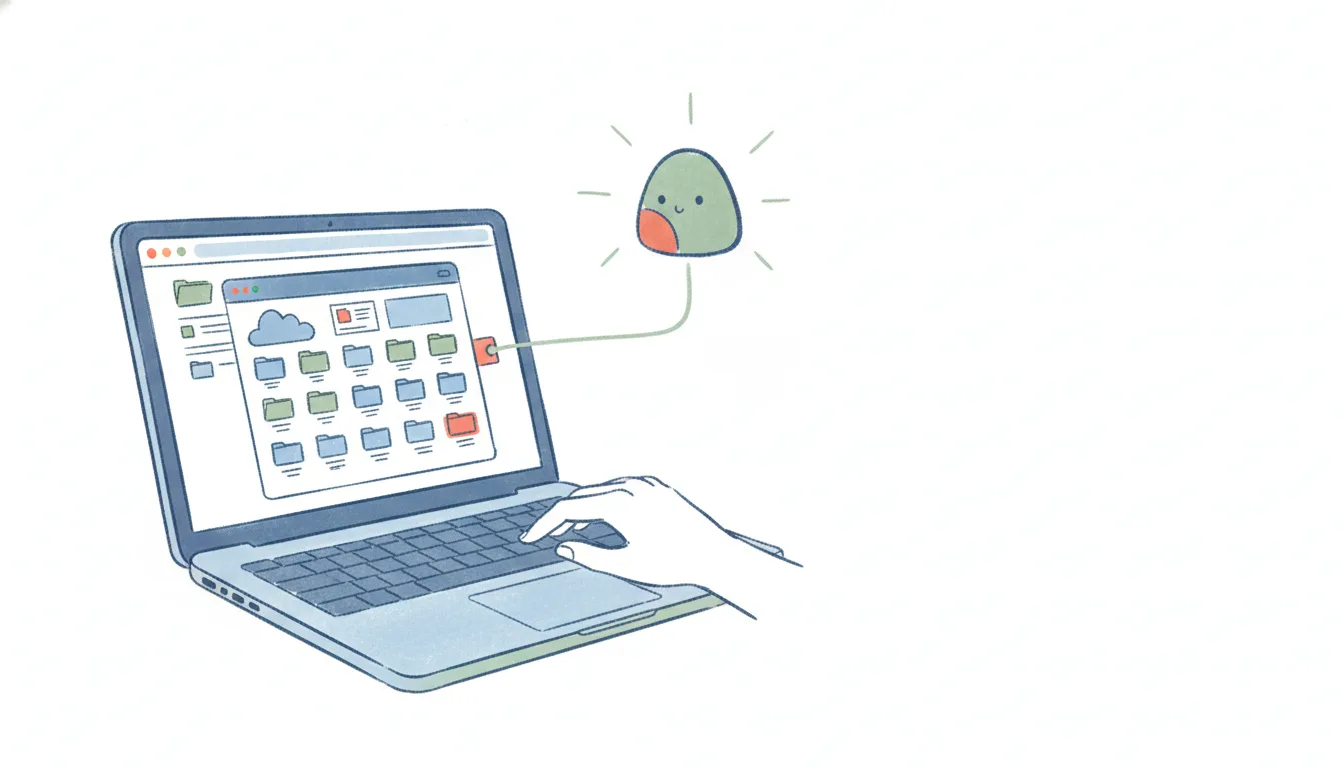
Google Drive MCP: Official, but Still in Preview
Yes — Google runs an official Drive MCP server, but it’s newer and more gated than most people expect. The server lives at drivemcp.googleapis.com and is part of Google’s own Workspace Developer Preview Program — meaning it’s real and Google-hosted, not a community hack, but it isn’t a simple one-click toggle for every Google account yet. Some AI clients (Claude among them) already offer it as a built-in connector; wiring it into your own tool means enrolling in the preview and standing up a Google Cloud project.
The bigger thing worth knowing before you go looking for it: an MCP server hands Drive to an AI inside a conversation you start. It’s a doorway, not a worker. Nothing watches your Drive for you, nothing fires when a file lands in a folder, and nothing runs while the chat is closed. Here’s exactly what the Google Drive MCP does, how to connect it, where it stops — and what to use when you want Drive work that runs on its own.
For the wider picture, every app with an MCP server is listed by category.
What the Google Drive MCP server does
Model Context Protocol (MCP) is the open standard that lets an AI client — Claude, Google Antigravity, Gemini CLI, and others — talk to an outside app through a shared interface. Google’s own Drive MCP server exposes eight tools:
- search_files and list_recent_files — find things by name, type, or recency instead of scrolling folders.
- read_file_content and download_file_content — pull the text or raw bytes of a doc, sheet, or file into the conversation.
- get_file_metadata and get_file_permissions — check who owns a file, when it changed, and who it’s shared with.
- create_file and copy_file — generate a new file or duplicate an existing one.
That’s a genuinely useful set for ad-hoc work: ask an AI to find last quarter’s budget sheet, summarize a proposal doc, or check who has access to a sensitive file, and it answers from your real Drive instead of guessing. What it notably doesn’t include is an “update” or “delete” tool — you can create and copy, but not edit a file in place through this server.
How to connect Google Drive to AI
The path depends on which AI client you’re using:
- If your AI client already has a Google Drive connector (Claude’s Pro, Max, Team, and Enterprise plans do) — turn it on in the client’s connector settings and authorize it through the OAuth prompt. The client is talking to Google’s official
drivemcp.googleapis.comserver behind the scenes; you don’t touch infrastructure. - If you’re wiring your own MCP client (a custom agent, Google Antigravity, or Gemini CLI) — you first enroll in the Google Workspace Developer Preview Program, then create a Google Cloud project, enable
drivemcp.googleapis.com, configure an OAuth consent screen, and generate client credentials. Google’s own docs walk through each step. - Either way, once connected, the AI can only see what your Google account is authorized to see — the same permissions you already have in Drive.
The first path is easy. The second is a real setup project, which is exactly why “official” doesn’t mean “effortless” here.
Where the Google Drive MCP stops
None of this is a knock on MCP — it’s just the shape of the protocol, plus Google’s own preview-program limits. Four things show up the moment you want more than a conversation:
- It only works inside a chat you start. Close the window and nothing happens. The AI doesn’t watch your Drive; it waits for you to ask.
- No triggers. A new file dropped into a shared folder, a doc someone else edited, a permission change — none of these can start anything through MCP. There’s no “when this lands in Drive, do that.”
- It’s one app at a time. The Drive MCP server knows Drive. Getting a new contract PDF into DocuSign, a Slack alert, and a project tracker row means wiring up (and authing) a separate MCP server for each, then hoping your client can juggle them in one turn.
- The server itself is still in developer preview. Google can change scopes, tools, or availability as the program evolves, and using it outside a client’s built-in connector means enrolling in a preview program rather than just flipping a switch.
So the Google Drive MCP is a solid way to ask about your Drive and make simple additions. It is not a way to make Drive run — to have work happen on a schedule or in reaction to a file change, across the other tools that file touches next.
Running Google Drive work that doesn’t need a chat open
That “run on its own, across apps” gap is exactly where Carly fits. Carly connects to Google Drive natively — no developer preview to join, no Cloud project to stand up, no OAuth consent screen to configure — and to the ~260 other apps it supports, plus anything with a public API through your own key. The difference from MCP is the important part: Carly’s workflows are triggered and scheduled, so Drive work happens whether or not anyone has a chat window open.
A few things MCP can’t do but a Carly workflow can:
- When a new file lands in a shared client folder → rename it to your naming convention, notify the account owner in Slack, and log it in a tracking sheet — automatically, the moment it appears.
- Every Friday → gather the week’s edited docs in a project folder and email a summary to the team.
- When a contract doc is finalized → route it for e-signature, file the signed copy back in Drive, and update the deal record — no one opening a chat to kick it off.
The non-AI steps — the moving, matching, and routing between apps — are free, the Zapier-style backbone of the workflow. The AI steps (drafting, summarizing, deciding) start at $35/month. You describe the outcome in plain language and Carly wires up the Google Drive connection and everything downstream.
If you just want to ask questions about your Drive from a chat, Google’s own MCP server (or a client that already bundles it) is the right tool. If you want Drive to actually do things — on a trigger, on a schedule, across every app a file touches — that’s the job MCP wasn’t built for, and it’s the one Carly was.
FAQ
Does Google Drive have an official MCP server?
Yes. Google runs drivemcp.googleapis.com directly, offering read tools (search, read, download, metadata, permissions) plus create and copy. It’s part of Google’s Workspace Developer Preview Program, so it’s official but still evolving rather than fully general availability.
Is the Google Drive MCP server free? The server itself doesn’t carry its own fee — you’re authorizing an AI client against your existing Google account and Drive permissions. Wiring it into your own client requires enrolling in Google’s preview program and standing up a Google Cloud project, which takes time but no separate license.
Can the Google Drive MCP trigger automations? No. MCP is request/response inside an AI chat — it has no triggers and nothing runs when the conversation is closed. For event- or schedule-driven Drive work across apps, you need a workflow tool like Carly rather than an MCP server.
Can I connect Google Drive to AI without coding or hosting a server? Yes. If your AI client already bundles the Drive connector you don’t have to touch MCP setup at all, and you still don’t get triggers or cross-app automation. Carly connects to Google Drive for you and lets you build the automation in plain language — describe what you want to happen and it wires up Drive and the other apps involved, with no server to host and no code to write.
Ready to automate your busywork?
Carly schedules, researches, and briefs you—so you can focus on what matters.
See what people say
"Before Carly, I relied on a Calendly link, but the whole process felt impersonal and not very professional. Carly changed that by handling all the back-and-forth, so I'm no longer stuck in endless email threads trying to line up schedules.
Now Carly reaches out to candidates, shares my real-time availability, lets them pick a slot, then sends a Zoom link and drops it straight into my calendar. She sends reminders to both of us before each call, which has significantly reduced no-shows and last-minute confusion.
On top of scheduling, Carly acts like a full executive assistant, sending me my schedule the night before so I can prepare for each call. It reminds me of the old x.ai assistant, but Carly is noticeably smarter, faster, and better suited to my healthcare recruitment business."