Lindy vs n8n: AI Assistant or Workflow Platform? (2026)
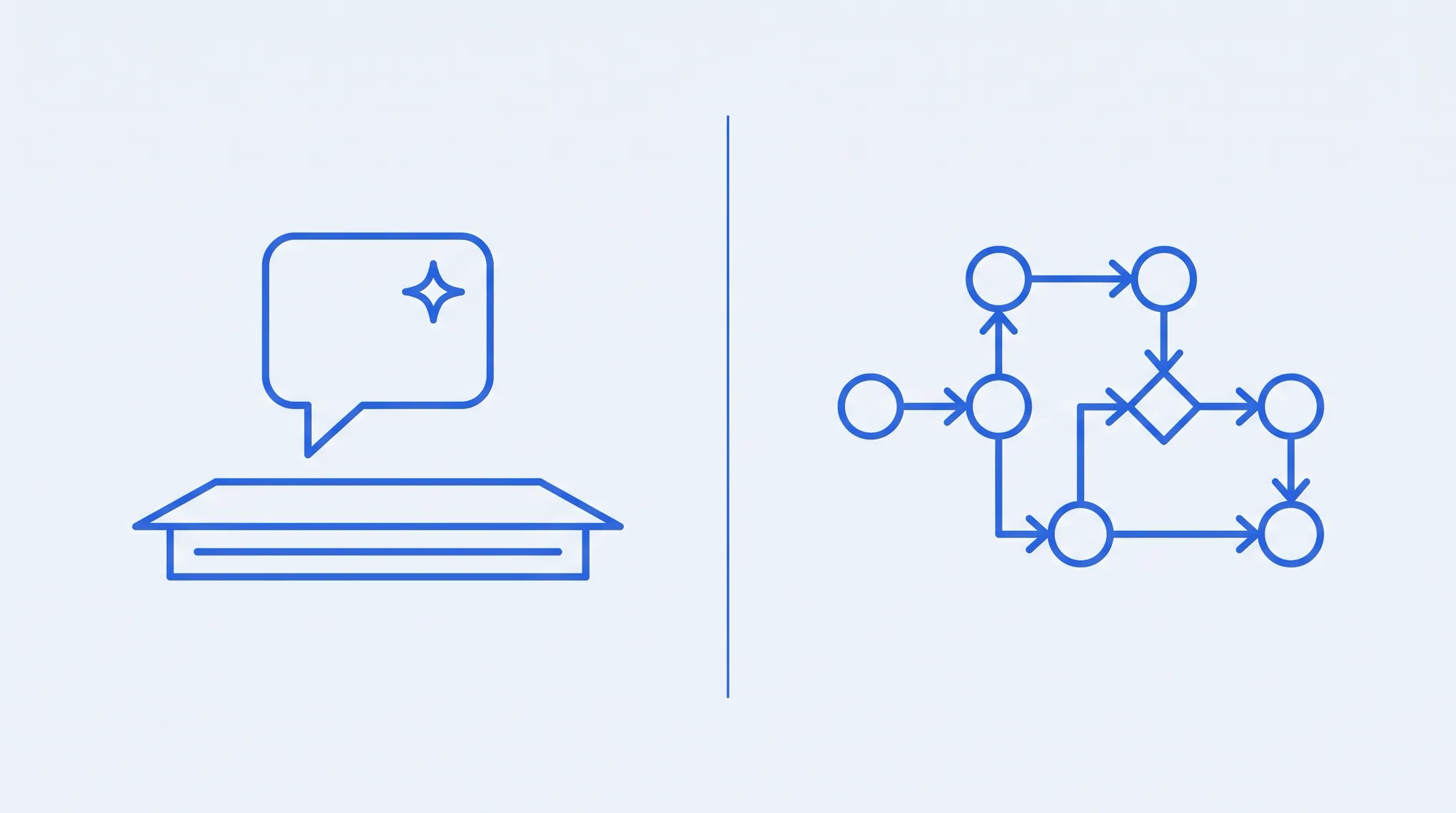
People compare Lindy and n8n because both promise “AI agents,” but they’re opposite answers to the question. Lindy is an AI executive assistant — you describe a job in plain English, and it triages email, schedules meetings, and runs follow-ups, metered by credits. n8n is a workflow platform — a node-based canvas where you assemble the automation (including AI agents) yourself, priced per execution and self-hostable for free. One is an employee you brief; the other is a factory you build.
The One-Sentence Answer
Use Lindy if you want to delegate work conversationally and will pay for that convenience; use n8n if you’re technical, care about cost at volume, and want full control over the machinery.
Side-by-Side Comparison
| Lindy | n8n | |
|---|---|---|
| What it is | AI executive assistant / agent platform | Node-based workflow automation platform |
| How you use it | Describe tasks in plain English; iMessage/SMS, web, email | Build workflows on a visual canvas; expressions, some JS/API literacy helps |
| AI story | The whole product — agents with memory that reason and act | Native AI Agent node (built on LangChain) plus 70+ AI nodes you wire together yourself |
| Billing unit | Credits — roughly 1–3 per task step on basic models, up to ~10 on large models; no rollover, agents pause at zero | Executions — one workflow run counts once, no matter how many steps |
| Price (2026) | From $29.99/month (Plus, 2 inboxes); $99.99 and $199.99 above that | From €20/month cloud (2,500 executions, billed annually); self-hosted Community Edition is free |
| Integrations | ”Hundreds” per its own integrations page (its comparison pages claim more) | 1,930 listed on its official integrations page |
| Hosting | Cloud only | Cloud or self-hosted (data stays on your servers) |
| Best fit | Founders/execs delegating inbox and calendar work | Ops and engineering teams running high-volume automation |
When to Use Lindy
- You want to hand off email triage, scheduling, and follow-ups by describing them, not building them
- You like operating an assistant from iMessage or SMS
- Nobody on the team wants to touch a node canvas or an API key
- Your volume is modest enough that credit metering won’t sting
- You want pre-built templates for common assistant jobs
Lindy’s pitch is speed-to-delegation: its own marketing shows an invoice-chasing agent taking three steps in Lindy versus nine nodes in n8n. That’s real — for a contained task, Lindy is running before an n8n beginner has connected their second node. The trade-offs are the meter (credits burn per step, and bigger models burn multiples) and the ceiling: you’re renting behavior, not building an asset you control.
When to Use n8n
- You (or someone on your team) are comfortable with APIs, JSON, and a visual builder
- Your automation runs at volume — thousands of runs a month — where per-execution pricing crushes per-task and per-credit pricing
- You want to self-host for data control or to pay nothing at all
- You want to assemble custom AI agents — n8n has a native AI Agent node plus 70+ AI nodes for models, memory, vector stores, and RAG
- Your workflows have complex branching, loops, and data transformation
One thing most Lindy-vs-n8n comparisons get wrong: they claim n8n has no real AI. That was true years ago; in 2026 n8n ships a LangChain-based Agent node, an AI Workflow Builder that generates workflows from natural language, and memory nodes — you just have to assemble the pieces. The honest contrast isn’t “AI vs no AI,” it’s pre-assembled assistant vs build-your-own.
The Cost Math Nobody Shows You
The sticker prices ($29.99 vs €20) hide the real difference, which is the billing unit.
- n8n counts a workflow run as one execution, regardless of steps. A 20-step workflow that runs 2,500 times a month fits in the €20 Starter tier. Self-hosted, it costs nothing.
- Lindy meters credits per task, with basic-model steps costing 1–3 credits and large-model steps up to around 10. Multi-step agents on capable models eat credits fast, and credits don’t roll over — when they’re gone, your agents pause until the next cycle or a higher tier.
For occasional, high-judgment tasks, Lindy’s meter barely registers. For anything that runs constantly — enrichment, routing, sync — n8n is an order of magnitude cheaper, which is why technical teams standardize on it.
The Question Behind the Question
If you’re comparing these two, you’re really asking: do I want an assistant or a pipeline? Pipelines (n8n) are for predictable, repeating flows. Assistants (Lindy) are for judgment work — reading an email thread, deciding what matters, replying appropriately.
But there’s a third position both miss. Lindy hands you drafts and waits for approval, so you’re still the last step in every loop — and n8n asks you to build and maintain the machinery yourself. Carly is an AI executive assistant whose agents each get their own real email address: you email a task or CC an agent on a thread, and it replies to people directly, books the meeting, sends the follow-up, and updates your tools — finished, not drafted. You describe what you want in plain English (no canvas, no nodes), it connects to 200+ integrations across 40+ categories, pricing starts at $35/month, and there’s a human support team behind it when something needs untangling. See Carly vs Lindy for the direct comparison.
Quick Reference
| Your situation… | Pick… |
|---|---|
| I want to delegate my inbox and calendar by texting | Lindy |
| I run thousands of automated executions a month | n8n |
| I need data to stay on my own servers | n8n (self-hosted) |
| Nobody here is technical | Lindy — or Carly |
| I want to build custom AI agents from parts | n8n |
| I want the work completed end to end, not drafted | Carly |
FAQ
Is n8n harder to learn than Lindy? Yes. Lindy is prompt-first — you describe the job. n8n is a node canvas where expressions, credentials, and API concepts matter. The payoff for that learning curve is control and much lower cost at volume.
Does n8n have AI agents like Lindy? It has the parts: a native AI Agent node built on LangChain, 70+ AI nodes covering chat models, memory, embeddings, and vector stores, and an AI Workflow Builder. You assemble the agent yourself, whereas Lindy ships one ready to brief.
Which is cheaper, Lindy or n8n? At low volume they’re comparable ($29.99/month vs ~€20/month cloud). At high volume n8n wins decisively because one workflow run is one execution regardless of steps — and self-hosting is free. Lindy’s per-credit metering grows with both step count and model size.
What if I want an assistant but not the babysitting? Lindy drafts and waits for your approval by default. If you want replies sent, meetings booked, and tools updated without you in the middle, look at Carly — or see the wider field in Lindy alternatives.
Related: Carly vs Lindy · Lindy AI review · Lindy AI pricing · Lindy vs Zapier · Lindy alternatives · n8n alternatives
Ready to automate your busywork?
Carly schedules, researches, and briefs you—so you can focus on what matters.
See what people say
"Before Carly, I relied on a Calendly link, but the whole process felt impersonal and not very professional. Carly changed that by handling all the back-and-forth, so I'm no longer stuck in endless email threads trying to line up schedules.
Now Carly reaches out to candidates, shares my real-time availability, lets them pick a slot, then sends a Zoom link and drops it straight into my calendar. She sends reminders to both of us before each call, which has significantly reduced no-shows and last-minute confusion.
On top of scheduling, Carly acts like a full executive assistant, sending me my schedule the night before so I can prepare for each call. It reminds me of the old x.ai assistant, but Carly is noticeably smarter, faster, and better suited to my healthcare recruitment business."