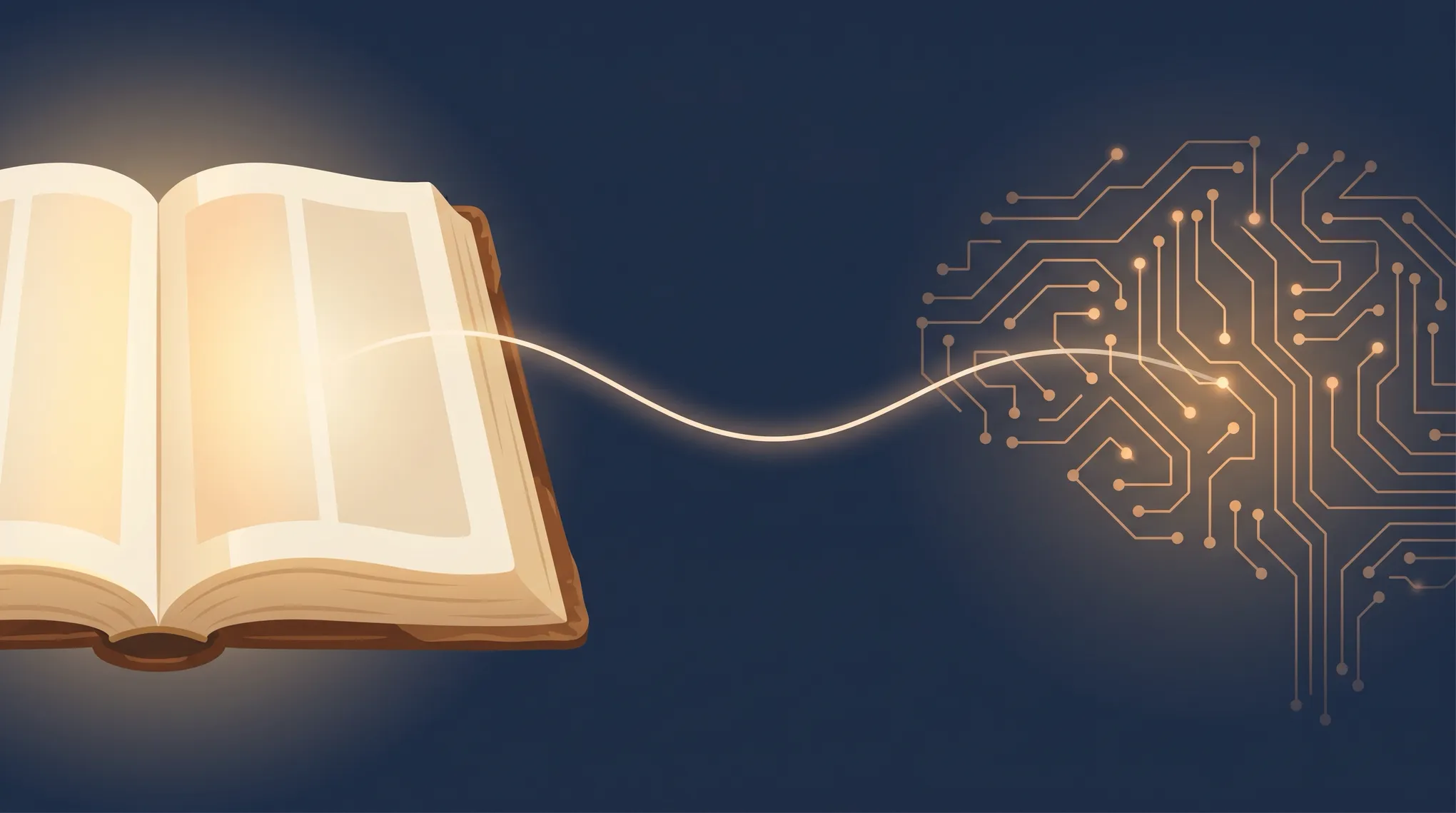
What Does the Bible Say About AI?
The short answer
The Bible never mentions artificial intelligence. It was written between roughly 1500 BC and AD 100, long before circuits or code. So there is no verse that names AI, predicts it, or rules on it directly.
What Scripture does do is speak to the questions AI forces on us: What makes a human a human? Where does wisdom come from? What happens when people build something powerful to make a name for themselves? How do you tell truth from a convincing lie? On those questions the Bible has a great deal to say — and that is where any honest answer has to start.
Made in the image of God — and AI is not
The foundational claim about people comes in the first chapter of the Bible: “So God created man in his own image, in the image of God he created him” (Genesis 1:27). Being made in God’s image — the imago Dei — is what theologians point to for human dignity, conscience, moral responsibility, and the capacity to know and worship God.
An AI model can imitate a great deal of that. It can write a prayer, explain a doctrine, or hold a conversation that feels warm. What it cannot do is be any of it. It has no conscience to convict, no soul to save, no capacity to repent or worship. Most Christian writers land here: AI sharpens the contrast rather than blurring it. A system that mimics a person makes plainer what only a person actually possesses.
Knowledge is not wisdom
The Bible draws a hard line between information and wisdom — and AI sits squarely on the information side. “The fear of the LORD is the beginning of knowledge” (Proverbs 1:7); “the beginning of wisdom” a few chapters later (Proverbs 9:10). In the biblical frame, wisdom is not raw data — it is rightly ordered knowledge that begins in reverence for God and shows up as character.
A model can hold more facts than any human and still have no wisdom in this sense, because wisdom is moral and relational, not statistical. That is a useful guardrail: AI is a remarkable tool for knowledge, and a poor substitute for the wisdom Scripture says comes from God and is formed in a life.
The Tower of Babel and the urge to “make a name”
The story most often connected to AI is the Tower of Babel (Genesis 11). A united humanity pools its technology — “Come, let us build ourselves a city and a tower with its top in the heavens, and let us make a name for ourselves.” The problem was never the building. It was the motive: autonomy from God and self-exaltation through a shared technical project.
Babel is not a prophecy about AI. It is a pattern. When human ingenuity is bent toward replacing God, controlling our own destiny, or worshiping our own cleverness, Scripture treats that as the danger — not the engineering itself. The same tool can be built to serve people or to enthrone them. The Bible’s interest is in the heart behind it.
Stewardship: tools can serve good ends
Scripture is not anti-technology. Humanity is given dominion and told to cultivate and keep the world (Genesis 1:28), and the Bible celebrates skilled craftsmen filled with the Spirit to do good work (Exodus 31). The governing principle is stewardship: “Whether you eat or drink, or whatever you do, do all to the glory of God” (1 Corinthians 10:31).
By that measure AI is morally like any tool — a hammer, a printing press, a search engine. It can ease burdens, extend care, and free people for better work, or it can deceive, exploit, and displace. The ethical weight falls on how it is built and used, and to what end.
Discernment and the warning against deception
Where Scripture gets pointed is on deception. Believers are told to “test the spirits” (1 John 4:1), to be “wise as serpents and innocent as doves” (Matthew 10:16), and to watch that no one takes them “captive by philosophy and empty deceit” (Colossians 2:8).
That maps almost too neatly onto modern AI, which can produce fluent, authoritative text that is simply false. A model that confidently fabricates — what the industry calls a hallucination — is a discernment problem dressed up as a technology problem. “Lying lips are an abomination to the LORD” (Proverbs 12:22); the burden to verify and tell the truth stays with the human using the tool.
Is AI the “image of the beast”?
The most dramatic claim you will find online connects AI to Revelation 13:14-15, which describes a second beast that builds an image, gives it “breath” so that it can “speak,” and causes those who will not worship it to be killed. Some writers argue this fits a man-made system that is given a kind of life, speaks with a persuasive voice, and commands trust and obedience.
It is worth being careful here. Interpreters across church history have read that image as Rome, as a coming political power, or as a symbol — long before computers existed. Reading it as a literal prediction of AI is one popular interpretation, not the consensus of biblical scholarship. The sober takeaway is not a date or a gadget but a posture: Scripture warns against giving anything human-made the trust, allegiance, or worship that belongs to God alone. That warning holds whether or not AI is the specific thing in view.
What the Bible actually leaves you with
Put together, Scripture does not hand down a verdict on artificial intelligence so much as a set of questions to hold it against:
- Does this honor the dignity of people made in God’s image, or treat them as data?
- Am I chasing wisdom — which begins in reverence for God — or just more knowledge?
- Is this built to serve and steward, or to make a name and grab control?
- Am I exercising discernment, or trusting a fluent voice without testing it?
- Does anything here ask for trust that belongs to God alone?
The Bible’s answer to AI, in other words, is mostly an answer about us — our motives, our wisdom, and where we place our trust. The technology is new. The questions are very old.
Ready to automate your busywork?
Carly schedules, researches, and briefs you—so you can focus on what matters.
See what people say
"Before Carly, I relied on a Calendly link, but the whole process felt impersonal and not very professional. Carly changed that by handling all the back-and-forth, so I'm no longer stuck in endless email threads trying to line up schedules.
Now Carly reaches out to candidates, shares my real-time availability, lets them pick a slot, then sends a Zoom link and drops it straight into my calendar. She sends reminders to both of us before each call, which has significantly reduced no-shows and last-minute confusion.
On top of scheduling, Carly acts like a full executive assistant, sending me my schedule the night before so I can prepare for each call. It reminds me of the old x.ai assistant, but Carly is noticeably smarter, faster, and better suited to my healthcare recruitment business."