Slack vs Discord: Which Chat Platform Fits Your Team in 2026?
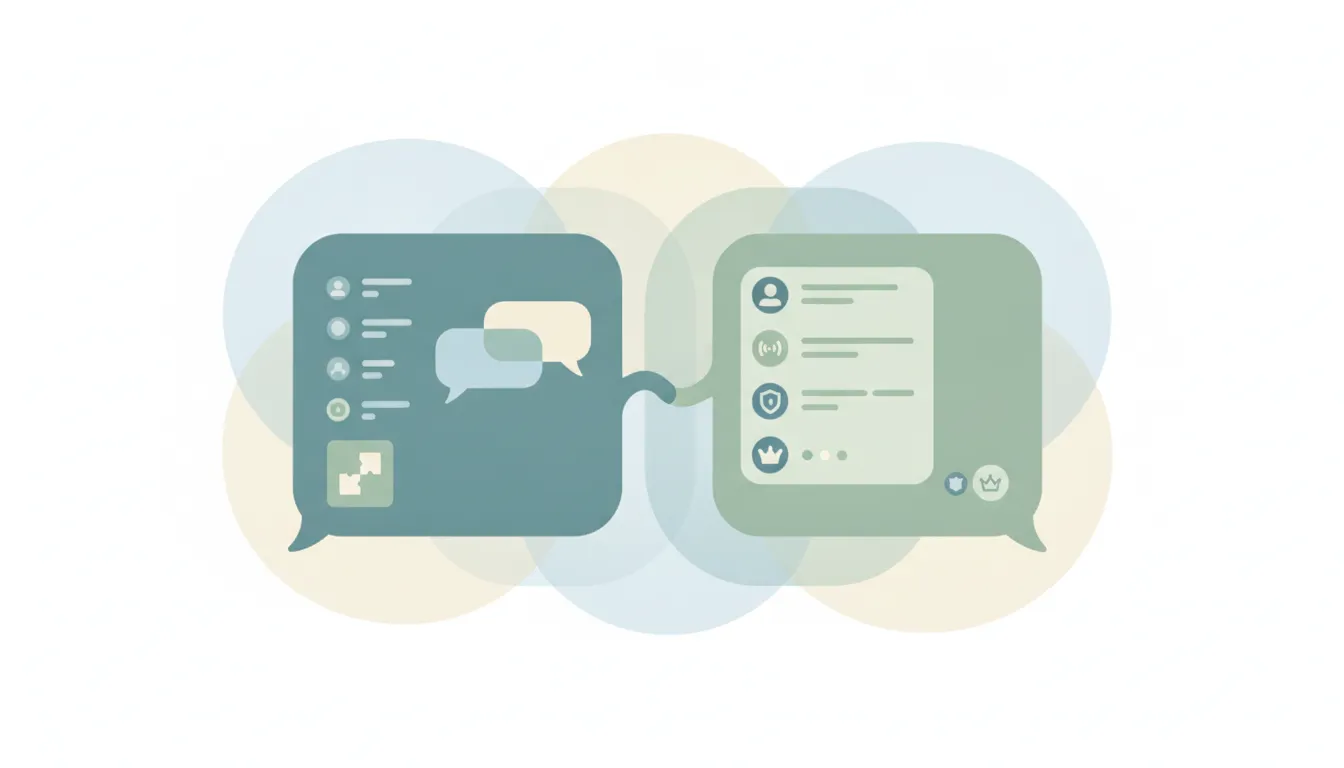
Slack and Discord are both channel-based chat apps, and on the surface they look similar: sidebars full of channels, threads, mentions, and voice. Under the hood they were built for opposite jobs, and that shows up the moment you scale past a handful of people. Slack is business team messaging: structured channels, thousands of workplace integrations, enterprise admin controls, and now an AI-agent version of Slackbot, all owned by Salesforce. Discord is a community-and-voice platform: servers, roles, and always-on voice rooms that started in gaming and now host everything from creator fandoms to startup communities. If you mainly want a compliant, integration-heavy work hub, pick Slack. If you mainly want a free, voice-first place for a community to gather, pick Discord.
The One-Sentence Answer
Choose Slack if you are running a business team that needs integrations, admin governance, and compliance; choose Discord if you are building a community that lives in casual chat and always-on voice.
Side-by-Side Comparison
| Slack | Discord | |
|---|---|---|
| Core strength | Structured business collaboration and workflows | Community engagement and persistent voice |
| How it works | Channels, threads, huddles, deep app integrations | Servers with text/voice channels, roles, and always-on voice rooms |
| Best known for | The default work chat for companies and startups | Gaming and creator communities, now broader groups |
| Pricing model | Per-seat: Free, Pro ( | Mostly free; per-user Nitro Basic ($2.99), Nitro ($9.99), Server Boosts ($4.99) |
| Free plan limits | 90-day message history, 10 app integrations, 5GB storage | Unlimited history, generous features, no enterprise controls |
| Integrations/ecosystem | 2,600+ business apps (Salesforce, Jira, Figma, etc.) | Bots and ~50 integrations per server; no native business-tool connectors |
| Compliance/admin | SOC 2, HIPAA, FedRAMP, SSO/SAML, SCIM, audit logs | No enterprise compliance certs, no SSO/SAML or SCIM |
| AI features | Slack AI (summaries, recap, search); Slackbot AI agent | No built-in AI assistant; relies on third-party bots |
| Ideal user | Companies, agencies, and regulated teams | Communities, creators, and casual groups |
When to Use Slack
- You run a paid team that needs channels tied to real business tools like Salesforce, Jira, or Figma.
- You work in a regulated industry and need SOC 2, HIPAA, or FedRAMP compliance, plus SSO and audit logs.
- You want unlimited searchable message history and an AI layer that can summarize threads and draft replies.
- You collaborate with clients or external partners through Slack Connect and want centralized admin control.
When to Use Discord
- You are building a community, not staffing a payroll, and want members to join for free.
- Your group values always-on voice rooms where people drop in and out without scheduling a call.
- You want granular roles, custom emoji, and moderation tools to shape a large public or semi-public space.
- You need a generous free tier with unlimited history and only pay for cosmetic perks like Nitro or Server Boosts.
Governance and Integrations vs Ambient Voice and Community Scale
The deciding axis is not features, it is what each platform assumes about your group. Slack assumes you are a company. Its per-seat pricing exists to fund the parts businesses actually pay for: unlimited history above the free plan’s 90-day cutoff, 2,600+ integrations, Slack Connect for working with external partners in shared channels, and the governance stack of SSO, SCIM provisioning, audit logging, and compliance certifications. In 2026 Salesforce leaned hard into that identity, turning Slackbot into a full AI agent (powered by an Anthropic model) that can find information, draft, and schedule, then announcing roughly 30 new AI features, including reusable skills and connections to external tools, to make Slack the front door to Salesforce. Companies like OpenAI, Anthropic, Notion, and Vercel are cited as building agents that live natively inside Slack. If your work touches regulated data or a real integration stack, most of that is non-negotiable, and Discord simply does not offer it.
Discord assumes you are a community. That is why the core product is free, voice is ambient rather than scheduled, and the paid tiers (Nitro Basic at $2.99, Nitro at $9.99, Server Boosts at $4.99) are personal cosmetic upgrades, not a business seat. There is no standard per-seat business plan at all; organizations that adopt Discord combine the free version with optional upgrades. The tradeoff is real: Discord caps integrations at roughly 50 per server, has no native connectors to business tools, and lacks SSO/SAML, SCIM, and enterprise compliance certs. For a 500-person creator community or an open-source project that lives in voice, none of that matters and the free ceiling is a gift. For a 40-person agency handling client contracts, those same gaps are dealbreakers. The gotcha for teams tempted by Discord’s price is compliance and admin control, and the gotcha for communities tempted by Slack is that the free plan’s 90-day history and 10-integration cap get frustrating fast.
The cost math splits the two clearly. Discord’s spend is optional and individual, so a 1,000-member server can run at genuinely $0 while power users pay for their own Nitro. Slack’s spend is mandatory and multiplies by headcount: a 25-person team on Pro is roughly $180 a month before you reach the Business+ tier where advanced Slack AI, the 99.99% uptime SLA, compliance exports, and SCIM live. That is the price of governance, and it is exactly what a startup building a public community does not want to pay, while a services firm answering to auditors is happy to. It is also why the choice rarely comes down to which app “feels” better in a demo. The feel is similar; the assumptions are not.
One more real-world wrinkle: some teams try to run both. A company keeps its internal work in Slack for compliance and integrations, then stands up a Discord server for its user community or open beta, where always-on voice and a free join button do more for engagement than any enterprise feature would. That split is common enough that “Slack or Discord” is often the wrong framing. The better question is whether the group in front of you is a payroll or a public, because that is what each platform is actually built to serve.
Rule of thumb: If people are getting paid to be there, use Slack; if they show up because they want to, use Discord.
Whichever hub you land on, the actual work (booking meetings, chasing email, running multi-step tasks) still happens outside the chat window. Carly is an AI executive assistant you email or text that can post updates to Slack, schedule meetings, and clear your inbox, so the messaging tool stays a place to talk while the admin gets handled. See how the Slack integration works if that is the side you want off your plate.
Quick Reference
| Your situation… | Pick… |
|---|---|
| Regulated industry needing compliance | Slack |
| Free community with always-on voice | Discord |
| Deep integrations with Salesforce, Jira, Figma | Slack |
| Large creator or fan community | Discord |
| Client work through external channels | Slack |
| Casual group that hangs out and drops into voice | Discord |
Related guides: Slack vs Teams · Slack free plan limits · best AI workflow automation tools
Ready to automate your busywork?
Carly schedules, researches, and briefs you—so you can focus on what matters.
See what people say
"Before Carly, I relied on a Calendly link, but the whole process felt impersonal and not very professional. Carly changed that by handling all the back-and-forth, so I'm no longer stuck in endless email threads trying to line up schedules.
Now Carly reaches out to candidates, shares my real-time availability, lets them pick a slot, then sends a Zoom link and drops it straight into my calendar. She sends reminders to both of us before each call, which has significantly reduced no-shows and last-minute confusion.
On top of scheduling, Carly acts like a full executive assistant, sending me my schedule the night before so I can prepare for each call. It reminds me of the old x.ai assistant, but Carly is noticeably smarter, faster, and better suited to my healthcare recruitment business."