What Is Claude Cowork? Anthropic's AI Coworker Explained
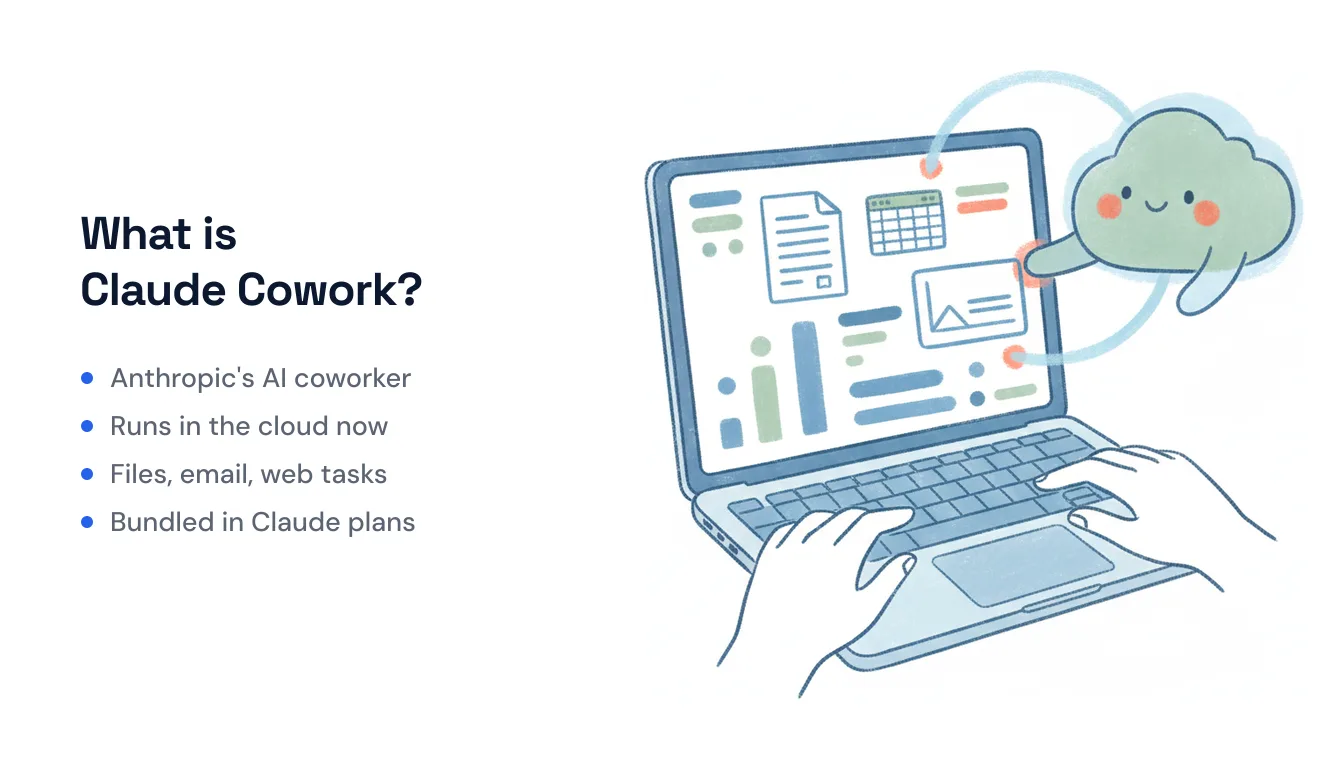
Claude Cowork is Anthropic’s agentic “coworker”: a mode inside the Claude apps where you describe an outcome, step away, and come back to finished work. Instead of a chat that answers one prompt at a time, Cowork takes on complex, multi-step jobs. It reads a folder of files, builds a spreadsheet, drafts a deck, runs a batch of research, then hands you the result to review. It is the same underlying Claude model you already talk to, pointed at doing work rather than describing it.
It launched to general availability on macOS and Windows on April 9, 2026, and on July 7, 2026 Anthropic expanded it to the web and mobile with an architectural change underneath that fixed the single biggest limitation of the desktop version.
On September 16, 2026, Anthropic merged Cowork and chat into one Claude: what Cowork could do is now available from any conversation, with your chats, projects, connectors and skills carried over. The merged app is rolling out to Pro and Max first, with Team and Free to follow.
Anthropic also ships eleven official plugins that arrive pre-configured for a role rather than making you assemble skills and connectors yourself. Claude Cowork plugins covers what each one packs and which components only run in Cowork, and Claude Cowork skills covers the layer underneath, where a folder with a SKILL.md file teaches Claude your own procedures.
If you have already decided to use it, how to use Claude Cowork walks through the setup choices that actually matter, starting with which surface to open it in.
How Claude Cowork works
You give Cowork a task and grant it access to the folders, apps, and tools it needs. It then plans the work, breaks it into steps, and executes them end to end, pausing to ask when it hits something ambiguous but otherwise running on its own. Per Anthropic’s getting-started guide, it can split a large project into parallel chunks and coordinate them, so a job like “clean up these 40 spreadsheets and summarize the trends” does not run one file at a time.
Two concepts organize the work:
- Tasks are a unit of work you can run on demand or schedule to run automatically on a cadence, such as every morning or every Monday.
- Projects are persistent, self-contained workspaces with their own files, links, instructions, and memory, so related tasks share context instead of starting cold.
The Projects model is worth understanding before you start, because it is the difference between an agent that re-learns your business every session and one that does not. Put your style guide, your account list and your standing instructions in a Project, and every Task inside it inherits them.
There is also a plugin marketplace and “computer use,” branded Dispatch, which lets Claude drive a real screen by opening apps and navigating a browser when a direct integration is not available. Dispatch is the escape hatch for the long tail: anything with a UI but no API is theoretically reachable, at the cost of being slower and more fragile than a real integration.
It now runs remotely, so your laptop no longer has to stay awake
This is the change that matters most, and the one most write-ups still get wrong.
The original desktop Cowork executed on your machine. Close the lid or let it sleep, and the work stopped. As of the July 2026 update, the web and mobile versions run remotely on Anthropic’s servers, in an isolated environment. Sessions are saved to your Claude account, so you can start a job on your phone, close the app, and pick up the same session on your laptop later.
The practical payoff, in Anthropic’s words: work continues after you close your laptop, and scheduled tasks fire with no device online at all. If you read older coverage claiming Cowork “only runs while your computer is awake and focused,” that was true of the first desktop release and is not true of the remote model. The New Stack and Help Net Security both covered the shift. The remote surfaces are in beta and rolling out starting with Max subscribers, with other plans following over subsequent weeks.
This is also the capability that most clearly separates Cowork from its closest competitor. ChatGPT Work has no recurring trigger at all: you start every task by hand. Cowork’s scheduled Tasks running unattended on remote infrastructure is a genuine structural advantage, and the full head-to-head is in ChatGPT Work vs Claude Cowork.
What Claude Cowork can do
The capability list is genuinely broad for a single agent:
- Read and write files in the folders you grant it, covering Word (.docx), PDF, CSV, Excel (.xlsx), PowerPoint (.pptx), Markdown, JSON, images, Jupyter notebooks, and most code files.
- Browse the web and fill forms. In Anthropic’s description, “Claude can open Chrome and work on websites, clicking, typing, navigating, and filling forms.”
- Build spreadsheets and slide decks. Excel files with working formulas and PowerPoint presentations, not text descriptions of them.
- Send email via the Microsoft 365 connector. When an admin enables write tools, Claude can send mail and manage calendar events on your behalf. The guardrails are worth knowing: it is off by default, admin-gated, adds an “agent-initiated” attribution header, and rejects any message with attachments. The separate Claude for Outlook add-in only drafts.
- Run multi-step plans that take an hour or more. The whole point is delegating jobs too big for a single chat turn.
- Run on a schedule. Recurring tasks that execute unattended on the remote infrastructure.
Where Claude Cowork runs
| Surface | Availability | Execution |
|---|---|---|
| macOS | GA (since Apr 9, 2026) | Local (accesses files and apps on device) |
| Windows | GA | Local |
| Web (claude.ai) | Beta (Jul 2026) | Remote (Anthropic’s servers) |
| iOS | Beta | Remote |
| Android | Beta | Remote |
The desktop apps also run on Linux and ChromeOS. The desktop versions can touch local files and apps directly; the web and mobile versions run in the cloud, which is exactly what lets scheduled tasks continue with nothing of yours online.
The split has a practical consequence people hit in their first week. If your work lives in a local folder, you want the desktop app. If you want unattended scheduled runs, you want the remote surfaces. Those are not the same client, and a workflow built around local file paths will not simply move to the cloud version.
Pricing: it is bundled into paid Claude plans
Cowork is not a separate purchase. It is included with every paid Claude subscription, and the plan you are on sets your usage limits:
| Plan | Price | Notes |
|---|---|---|
| Free | $0 | Does not include Cowork |
| Pro | ~$17/mo annual, $20/mo | Good for quick, everyday tasks |
| Max 5× | $100/mo | Higher limits for longer, heavier work |
| Max 20× | $200/mo | Highest limits |
| Team | Per seat | Includes the Slack connector |
| Enterprise | Contact sales | Admin controls, analytics, observability |
There is no metered add-on to buy. You are bounded by your plan’s usage limits, and heavier work, or a lot of scheduled tasks, pushes you toward Max. See Anthropic’s pricing page for current numbers, and our Claude Cowork pricing breakdown for how the limits behave in practice.
The budgeting nuance: because scheduled Tasks consume limits whether or not you look at the output, an unattended daily job is a standing draw on your allowance. Schedule the ones you actually read.
Who Claude Cowork is for
Cowork fits people who already live in the Claude app and want it to finish multi-step work rather than advise on it. Analysts building recurring reports, ops people cleaning and reconciling files, founders spinning up decks and research, developers automating repetitive local file work. Because it can browse, fill forms, and drive a screen, it also handles the long tail of tasks that have no clean API. The remote execution model makes it far more useful for anyone who wants scheduled, hands-off runs.
It is a weaker fit for two situations.
The first is work that needs to be reachable by other people. Cowork is primarily an agent you prompt. Anthropic has moved partway toward addressability with Claude Tag, where @Claude is a taggable Slack teammate with channel memory, ambient mode, channel-scoped admin tool grants and audit logs. That is real and worth knowing about, but it is Slack only, it runs on Enterprise and Team rather than individual plans, and a colleague tagging Claude is still a person asking rather than an event firing.
The second is event-driven work. Cowork’s triggers are schedules and your own requests. A new lead emailing you, a deal moving stage in the CRM, an invoice going unpaid for 30 days: those are events, and reacting to them automatically is a different shape of tool. Carly is built for that end: it gets its own email address so people and systems can reach it directly, and it fires on inbound triggers across 260+ integrations, with free Zapier-style workflows and AI agents from $35/month.
The two combine better than they compete, and you do not have to choose. Carly runs an MCP server at https://carlyassistant.com/mcp/, which you add in Claude under Customize then connectors. A Cowork run can then call Carly’s email, calendar, contacts and CRM, workflow, file and booking tools directly, which is useful precisely because Cowork’s own sending is Microsoft 365 only. The Cowork run does the thinking; Carly completes the action across the rest of your stack.
For solo, prompt-driven “do this big job for me” work inside Claude, Cowork is hard to beat, and it is already in a subscription you may be paying for. If you want to see the wider field, we keep Claude Cowork alternatives current.
One comparison worth making before you settle in: Cowork and Claude Code share an engine and a subscription, so the choice between them is never a purchase. Claude Cowork vs Claude Code covers where they actually diverge, including the fact that Claude Code routines can be started by an outside system and Cowork tasks cannot.
FAQ
What is Claude Cowork in one sentence?
It is Anthropic’s agent mode inside the Claude apps, generally available since April 9, 2026, that takes an outcome instead of a prompt, works independently for hours across your files and the web, and returns finished spreadsheets, decks and documents.
Does Claude Cowork keep running when I close my laptop?
On the web and mobile versions, yes. Since the July 2026 update those run remotely on Anthropic’s servers, and scheduled tasks fire with none of your devices online. The macOS and Windows desktop apps execute locally, so work there stops if the machine sleeps.
Can Claude Cowork run on a schedule?
Yes. Tasks can be set to run on a recurring cadence such as daily or weekly, and on the remote surfaces they run unattended. This is one of the clearest differences from ChatGPT Work, which has no recurring trigger.
How much does Claude Cowork cost?
There is no separate charge. It is bundled into paid Claude plans, starting at Pro, and your plan sets your usage limits. The Free tier does not include it. Heavy or heavily scheduled use tends to push people to Max at $100 or $200 per month.
Can Claude Cowork send email?
Yes, through the Microsoft 365 connector, but only when an admin has enabled write tools. It is off by default, adds an agent-initiated attribution header, and refuses any message with an attachment. The Claude for Outlook add-in drafts only.
What is Dispatch in Claude Cowork?
Dispatch is Anthropic’s name for computer use inside Cowork: Claude drives a real screen, opening applications and navigating a browser, for tasks where no direct integration exists.
Ready to automate your busywork?
Carly schedules, researches, and briefs you—so you can focus on what matters.
See what people say
"Before Carly, I relied on a Calendly link, but the whole process felt impersonal and not very professional. Carly changed that by handling all the back-and-forth, so I'm no longer stuck in endless email threads trying to line up schedules.
Now Carly reaches out to candidates, shares my real-time availability, lets them pick a slot, then sends a Zoom link and drops it straight into my calendar. She sends reminders to both of us before each call, which has significantly reduced no-shows and last-minute confusion.
On top of scheduling, Carly acts like a full executive assistant, sending me my schedule the night before so I can prepare for each call. It reminds me of the old x.ai assistant, but Carly is noticeably smarter, faster, and better suited to my healthcare recruitment business."