Best AI Assistant for Recruiters in 2026 (7 Tools, Ranked)
An AI assistant for recruiters isn’t a chatbot bolted onto your careers page. It’s the thing that answers the candidate at 9pm, holds the interview slot before it disappears, and updates the ATS so your pipeline reflects reality instead of your memory. The best candidates are off the market in about 10 days, and recruiters lose nearly a full day a week to admin. The right assistant buys that day back.
The seven tools below split into two camps: general assistants that run your inbox, calendar, and ATS end to end, and specialists that go deep on one stage — sourcing, scheduling, or interview notes. Most recruiting teams end up running one of each. Here’s how they compare.
AI assistants for recruiters at a glance
| Tool | Best for | ATS updates | Own inbox candidates email | Starting price |
|---|---|---|---|---|
| Carly | Inbox triage, scheduling, ATS updates, follow-ups | Yes (Ashby, Lever, Recruitee, Workable + BYO-key) | Yes | Free workflows; AI from $35/mo |
| Paradox (Olivia) | High-volume candidate self-scheduling | Yes (conversational ATS) | Via chat/SMS/WhatsApp | Custom (enterprise) |
| GoodTime | Complex panels and interview loops | Yes | No | Custom (enterprise) |
| hireEZ | Open-web sourcing and outreach | Two-way sync | No | Custom |
| Metaview | Interview notes and intake | Yes (pushes notes) | No | Free tier; paid per seat |
| candidate.fyi | Candidate-facing scheduling portal | Yes | No | Paid per seat |
| ChatGPT / Claude | Drafting JDs, outreach, screening rubrics | No | No | ~$20/mo |
1. Carly — AI assistant that runs your recruiting inbox
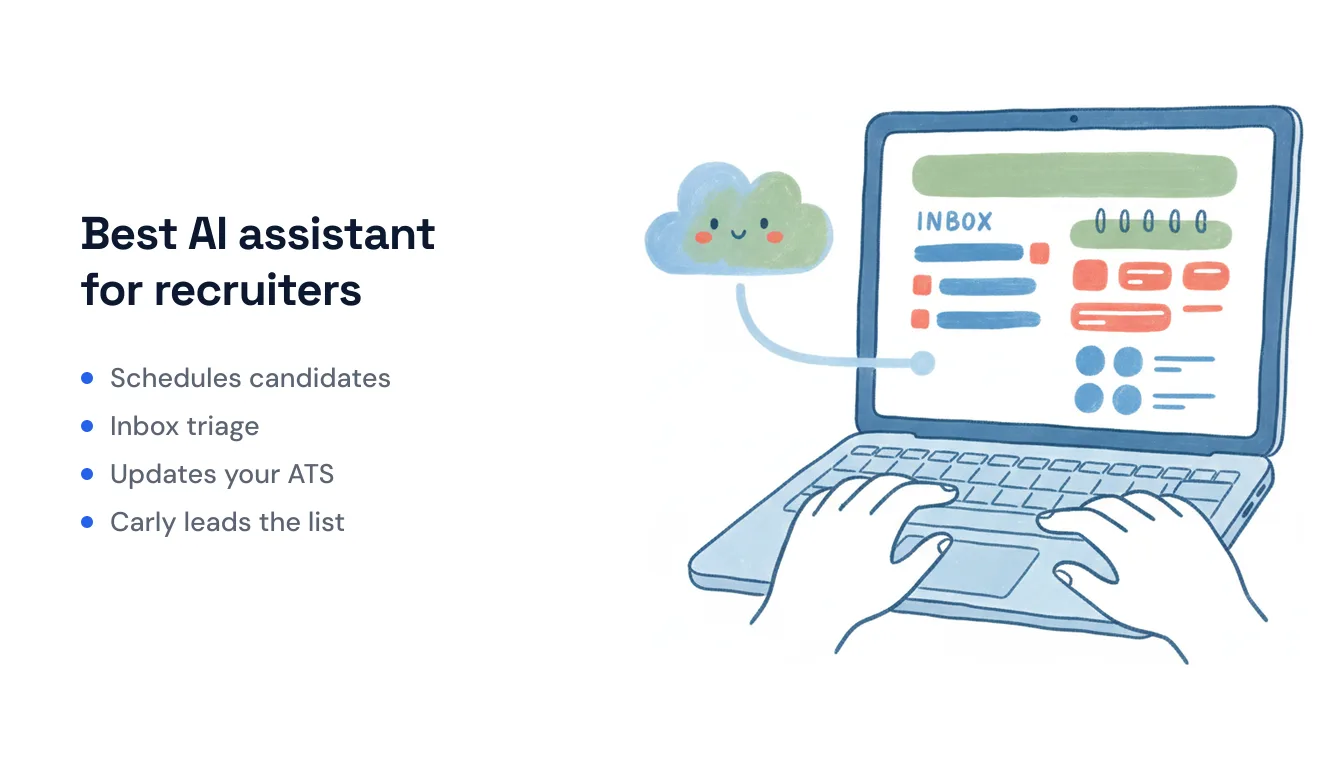
What it is: Carly is an AI executive assistant that lives in email. You spin up an agent from the dashboard, give it its own name and email address, and hand it the coordination work you’d otherwise do by hand. Candidates and hiring managers email or text it directly; it replies and does the work underneath — booking interviews, triaging inbound applicants, updating the ATS, and chasing the follow-ups that fall through the cracks. Nothing to install, and it works over Gmail and Outlook.
Why recruiters pick it: The grind in recruiting isn’t the interviewing, it’s the connective tissue between stages. Carly handles that connective tissue as an actual inbox. Forward a candidate thread and it schedules the screen across time zones, sends the confirmation, and adds the reminder. CC it on a panel request and it juggles three interviewers plus the candidate without the reply-all chain. It reads inbound applications, triages them by role, and drafts the reply.
Because Carly connects through server-side APIs — not by driving a browser — it can write straight into your applicant tracking system. It has native connectors for Ashby, Lever, Recruitee, and Workable, so an agent can log a new candidate, move someone to the next stage, or drop interview notes onto a profile as part of the same workflow that scheduled the call. Anything without a native connector — a boutique ATS, your HRIS, a sourcing tool — connects with your own API key from the integrations dashboard, so there’s no “Carly can’t reach that” wall. It also spans the rest of your stack: calendar, Slack, BambooHR, Gusto, and 260+ apps across 45+ categories.
That lets you build agents for real recruiting jobs rather than single tasks: an intake agent that logs every inbound applicant to the ATS and books qualified ones, a scheduling agent that owns interview coordination for a req, and a follow-up agent that nudges silent candidates and reminds hiring managers to leave feedback. Carly’s free booking pages give candidates a no-cost self-schedule link for standardized screens.
Pricing: Free Zapier-style workflows; AI agents from $35/month. See how it works as an AI scheduling assistant for recruiters, or read how recruiters fill roles faster with AI agents.
The tradeoff: Carly is a generalist assistant, not a sourcing engine. It won’t scrape 800M profiles off the open web — pair it with a sourcing specialist below if inbound isn’t enough to fill your pipeline.
2. Paradox (Olivia) — conversational assistant for high-volume hiring
What it is: Paradox built Olivia, a conversational recruiting assistant aimed at high-volume roles — retail, hospitality, healthcare, hourly work. Candidates interact by chat, SMS, WhatsApp, or email, and Olivia screens them with knockout questions, answers FAQs about pay and benefits, and lets them self-schedule interviews against a hiring manager’s calendar.
Why recruiters pick it: When you’re filling hundreds of similar roles, Paradox’s numbers are hard to argue with — one widely cited case dropped scheduling time from roughly 26 hours to 18 minutes. Its 2026 push into “agentic recruiting” adds flagging candidates who ghost interviews and re-engaging applicants who dropped off mid-process. For a store or warehouse hiring at scale, Olivia is a strong fit.
The tradeoff: Paradox is built around the applicant funnel for volume hiring, not around the recruiter’s own inbox and cross-functional coordination. It’s an enterprise product with custom pricing and an implementation, which is heavier than a corporate or agency recruiter filling a handful of professional roles needs.
3. GoodTime — interview orchestration for complex loops
What it is: GoodTime specializes in the hardest scheduling problem in recruiting: multi-stage interview loops and panels. Its “Orchestra” system auto-assigns interviewers based on availability and training status, swaps in replacements when conflicts arise, and balances interview load across a team so the same three senior engineers don’t get buried.
Why recruiters pick it: For enterprise teams running 100+ interviews a month with multi-person panels, GoodTime’s depth is real — it reports coordinating over 14 million interviews and cutting scheduling time by 78% versus manual work. It’s also expanding into broader assistant territory: advancing qualified candidates, sending rejections, and triggering recruiter briefings.
The tradeoff: GoodTime is priced and built for enterprise interview operations. It’s overkill for a solo recruiter or a small agency, and it doesn’t act as an inbox candidates email directly for everything else — it’s the panel engine, not the all-purpose assistant.
4. hireEZ — sourcing assistant that fills the top of funnel
What it is: hireEZ is an agentic sourcing platform that finds candidate profiles across the open web — LinkedIn, GitHub, Stack Overflow, academic and conference sources — then automates the search-to-outreach sequence on top of your ATS. It searches an aggregated pool of 800M+ profiles and can run AI phone screens with a job-fit summary at the end.
Why recruiters pick it: If your problem is an empty pipeline rather than a messy inbox, hireEZ is the specialist. Its EZ Agent chains sourcing steps (search, shortlist, outreach, follow-up), and it does two-way sync with Greenhouse, Lever, and Workday so sourced candidates land in the systems you already run.
The tradeoff: hireEZ is a top-of-funnel tool. It sources and engages, but it isn’t the assistant coordinating your interview logistics or triaging inbound applicants day to day. Pricing is custom and oriented to teams doing serious outbound sourcing.
5. Metaview — assistant for interview notes and intake
What it is: Metaview is an AI notetaker built for recruiting. It captures intake meetings and interviews on Zoom, Teams, Google Meet, and phone, then turns them into structured notes — bullets or paragraphs, tuned to your workflow — and pushes them onto the candidate profile in Ashby, Greenhouse, Lever, or Workday.
Why recruiters pick it: The recruiter can actually run the conversation instead of typing, and the hiring manager gets clean, comparable notes on every candidate. Metaview also builds an ideal-candidate profile from your JD and refines it as hiring decisions come in, plus TL;DR summaries and video snippets of key moments.
The tradeoff: Metaview is a documentation and intelligence layer, not a scheduler or an inbox. It records and structures what happened in the interview; it doesn’t book the interview or move the candidate along. It pairs naturally with a coordination assistant.
6. candidate.fyi — candidate-facing scheduling portal
What it is: candidate.fyi puts a branded scheduling and status portal in front of candidates so they can pick interview slots, see where they are in the process, and get updates without emailing the recruiter. It syncs with your ATS to keep stages current.
Why recruiters pick it: A polished candidate experience reduces drop-off, and self-service booking eliminates coordination for standardized stages. For teams that want candidates to feel informed rather than chased, the portal is a nice front end.
The tradeoff: It’s focused on the candidate-facing scheduling surface. It doesn’t run the recruiter’s inbox, triage inbound applications, or handle the internal hiring-manager coordination that eats the other half of your week.
7. ChatGPT / Claude — general assistants for the writing
What it is: ChatGPT and Claude are general-purpose AI assistants. They don’t touch your ATS or calendar on their own, but they’re the fastest way to draft the words recruiting runs on.
Why recruiters pick it: Job descriptions, outreach sequences, screening rubrics, interview questions, rejection notes, Boolean search strings — all of it drafts in seconds. Every recruiter should have one open. Claude in Chrome and ChatGPT Atlas can now also click around live pages in the browser, which helps for one-off research, though driving a site’s UI is more brittle and supervised than the API-based automation a purpose-built assistant uses.
The tradeoff: These are chat windows you prompt, not agents candidates email. They won’t book the interview, update the pipeline, or follow up on their own — that’s the gap the assistants above fill. Compare general assistants in our best AI personal assistants roundup.
How to choose your recruiting assistant
Pick by your biggest bottleneck, not by feature count:
- Drowning in coordination, follow-ups, and a chaotic inbox? Carly — an assistant with its own email that schedules, triages, and updates Ashby, Lever, Recruitee, or Workable end to end.
- Hiring hundreds of hourly roles? Paradox for conversational, high-volume self-scheduling.
- Running complex panels at an enterprise? GoodTime for interviewer load balancing and loop orchestration.
- Pipeline too thin? hireEZ for open-web sourcing and outreach.
- Interview notes inconsistent? Metaview to capture and structure every conversation.
- Want a slicker candidate experience? candidate.fyi’s scheduling portal.
- Need to write faster? ChatGPT or Claude for JDs, outreach, and rubrics.
Most teams run a generalist assistant for coordination plus one specialist for their weakest stage. If that weakest stage is everything between “candidate replies” and “offer sent,” start with the assistant that owns the inbox.
Frequently asked questions
What’s the difference between an AI recruiting assistant and an ATS?
An ATS stores your candidates and pipeline; an AI assistant does the work around it — scheduling, triaging inbound applicants, drafting replies, and updating the ATS so records stay current. The best assistants write into your ATS through its API rather than replacing it. Carly connects natively to Ashby, Lever, Recruitee, and Workable, and to anything else via your own API key.
Can an AI assistant schedule interviews across time zones and panels?
Yes. Carly coordinates candidates and multiple interviewers over email, GoodTime orchestrates complex enterprise loops, and Paradox handles high-volume candidate self-scheduling. For standardized screens, a self-service booking link removes the back-and-forth entirely.
Which AI assistant is best for a solo or agency recruiter?
An assistant that runs your inbox end to end usually beats an enterprise platform for a small team. Carly starts with free workflows and AI agents from $35/month, with no implementation project. Enterprise tools like GoodTime and Paradox use custom pricing built for large in-house teams.
Do these assistants work with Gmail and Outlook?
Carly works over both Gmail and Outlook and coordinates across Google and Microsoft calendars. Interview-scheduling specialists sync with hiring managers’ calendars on both platforms; check each tool’s calendar support for your exact setup.
Ready to automate your busywork?
Carly schedules, researches, and briefs you—so you can focus on what matters.
See what people say
"Before Carly, I relied on a Calendly link, but the whole process felt impersonal and not very professional. Carly changed that by handling all the back-and-forth, so I'm no longer stuck in endless email threads trying to line up schedules.
Now Carly reaches out to candidates, shares my real-time availability, lets them pick a slot, then sends a Zoom link and drops it straight into my calendar. She sends reminders to both of us before each call, which has significantly reduced no-shows and last-minute confusion.
On top of scheduling, Carly acts like a full executive assistant, sending me my schedule the night before so I can prepare for each call. It reminds me of the old x.ai assistant, but Carly is noticeably smarter, faster, and better suited to my healthcare recruitment business."