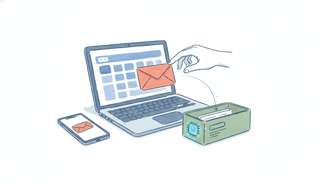
How to Get Started With Carly
There are three ways to use Carly, and picking the right one is most of the work.
Email carly@usecarly.com when you want something done now. Set up a workflow when you want the same thing to happen every time without being asked. Create an email agent when the job needs its own address that other people can write to.
Just email Carly
Every account gets Carly at carly@usecarly.com. No setup, no dashboard.
To: carly@usecarly.com Subject: Call with Jamie
Reach out to jamie.torres@newco.io and set up a 30-minute call next week. We’re covering the Q2 roadmap.
She books meetings, drafts and sends mail, updates contacts and CRM records, researches people and companies, and files documents. Ask in plain English and she asks back if something is ambiguous.
The reach matters more than the task list. Carly connects natively to around 260 apps across 45 categories: HubSpot, Salesforce, Pipedrive, Notion, Linear, Slack, Stripe, Shopify, Typeform, Airtable, QuickBooks, Xero, GitHub, Zoom, and the rest. For anything outside that catalog with a public API, paste your own key at carlyassistant.com/integrations and she works against it the same way. See the full list on the integrations page.
That means the question is rarely whether Carly can reach a tool. It’s usually whether the job should be a request, a workflow, or an agent.
Set up a workflow
A workflow is the same instruction, running forever, without you in the loop. You don’t build it. You describe the outcome and Carly wires it up, dry-runs it against a real recent event from your account, and shows you the output of every step before anything goes live.
“Every ten minutes, find the follow-ups I just sent and log each one as a note on the matching lead in HubSpot.”
“When a Gmail message arrives with an invoice attached, save the PDF to that client’s Drive folder and label the thread Receipts/Filed.”
“On the first of the month, pull last month’s P&L from QuickBooks and email me revenue, margins, and the big expenses.”
Workflows can start from a new email, a calendar event being created or cancelled, a set number of minutes before a meeting begins, a schedule down to every ten minutes, an event in a connected app like a paid Stripe invoice or an opened pull request, a webhook URL Carly mints for your own script, an RSS feed publishing, or a new row in a sheet.
This is where most CRM hygiene, receipt filing, reconciliation review, and reporting belongs. The work is repetitive and the trigger is obvious, so there’s no reason to ask twice. Around 200 starter templates ship in the dashboard, and the use cases page has copy-and-send prompts for the common ones.
Give a job its own address
An email agent is a separate address with its own instructions and its own scoped tool access. The distinction that matters: other people email it, not just you.
That’s the whole reason to reach for one. A workflow reacts to an event. An agent holds a conversation with whoever wrote in, on a handle you can publish on your site or hand to a client.
Set one up
- Open Email Agents in your dashboard and click Add Email Agent
- Pick a handle that matches the role, like
intake@orhiring@. The dashboard flags handles that are taken or reserved - Write the instructions
- Toggle on the tools it needs
- Choose how it sends
- Save. It’s live immediately
Write instructions that hold up unattended
Be specific about the sequence, not the vibe. This one runs an intake desk:
You handle new client inquiries for [Company].

When someone emails you:
1. Pull out their name, company, what they're trying to do,
   timeline, and budget range if they mention it
2. Create a CRM contact and set Deal Stage to "Inquiry"
3. Save any attachments to the Client Inquiries folder in Drive
4. Reply confirming you got it and ask about whatever they
   left out of step 1
5. If they ask to talk, check my calendar and offer three times

If you're missing something you need, ask one clarifying
question. Don't guess.

Tone: warm, direct, under 150 words.
Four things make the difference between an agent that runs unattended and one you end up babysitting: spell out the sequence rather than the goal, name the tone, say explicitly what to do when information is missing, and keep it under 500 words.
What you can give it access to
Scope each agent to what its job needs and nothing else:
| Access | What it covers |
|---|---|
| Calendar | Read and create events |
| Gmail / Outlook Mail | Send, read, and reply |
| Contacts and CRM | Create and update records |
| Google Drive / OneDrive | Upload, find, and organize files |
| Web search and person lookup | Research people, companies, topics |
| Connected apps | Every app you’ve connected, from HubSpot to Stripe to Linear |
| Your own API keys | The custom keys you’ve added, granted per agent |
| Workflows | Let the agent run and manage your automations |
| Scheduling | Let the agent set its own follow-ups and reminders |
| Knowledge base | Answer from documents you’ve uploaded rather than general knowledge |
| Data tables | Read and write your own structured records |
| Memory | Remember context across separate conversations |
An intake agent needs calendar, contacts, Drive, and mail. A research agent might only need web search and lookup. Scoping is a real control, not a formality: an agent can only touch what you switch on.
Choose how it sends
Assistant sender puts mail out from the agent’s own address, which is what you want for a published handle like support@.
Your Gmail or Outlook sends from your connected account, so recipients see your name and domain, and replies land in your inbox. Use it for client work, proposals, and anything that should feel like it came from you.
Which one to reach for
| You want | Use |
|---|---|
| Something done today | Email Carly |
| The same thing every time an event happens | A workflow |
| A CRM, sheet, or folder kept current on its own | A workflow |
| A report on a schedule | A workflow |
| An address other people can email | An email agent |
| Client intake, applications, or inbound support | An email agent |
| A job that needs its own instructions and limited access | An email agent |
They stack. A published hiring@ agent replies to candidates and books screens, while a workflow behind it scores every resume that lands and drops the strong ones in your inbox.
FAQ
Do I have to pick one?
No. Most accounts use all three. Email Carly for one-offs, workflows for anything repetitive, agents for handles other people write to.
How many agents and workflows can I have?
No hard limit on either. Each agent gets its own address, instructions, and tool configuration.
Can other people email my agent?
Yes, and that’s usually the point. Publish the address on your site and it handles first responses on its own.
What’s the difference between Carly and an email agent?
Carly is your general assistant across everything you’ve connected. An email agent is a single-purpose address with its own instructions and a deliberately narrow slice of tools. Carly is the assistant. Agents are the desks.
Can Carly work with an app that isn’t in the catalog?
Yes. If it has a public API, paste your key at carlyassistant.com/integrations and Carly can do whatever that API allows. For anything gated behind a vendor rep, book a call and we’ll look at the access path with you.
Can I change an agent after I create it?
Yes. Open it in the Email Agents tab and update the instructions, tools, or sending mode. Changes take effect on the next message.
How do I know a workflow is doing the right thing?
Carly previews it against real recent data from your account before saving, and every run logs each step’s input and output afterward. When something breaks, open the run and tell her which step to fix.
Ready to automate your busywork?
Carly schedules, researches, and briefs you—so you can focus on what matters.
See what people say
"Before Carly, I relied on a Calendly link, but the whole process felt impersonal and not very professional. Carly changed that by handling all the back-and-forth, so I'm no longer stuck in endless email threads trying to line up schedules.
Now Carly reaches out to candidates, shares my real-time availability, lets them pick a slot, then sends a Zoom link and drops it straight into my calendar. She sends reminders to both of us before each call, which has significantly reduced no-shows and last-minute confusion.
On top of scheduling, Carly acts like a full executive assistant, sending me my schedule the night before so I can prepare for each call. It reminds me of the old x.ai assistant, but Carly is noticeably smarter, faster, and better suited to my healthcare recruitment business."