AI Voice Agent for Customer Service: Costs and What to Check
Most support calls are the same five questions: where’s my order, how do I return this, why was I charged, can I move my appointment, can you update my details. An AI voice agent can answer all five at 9pm on a Sunday.
What decides whether customers stay is the sixth call, the one that needs a person, and how fast the agent gets them to one.
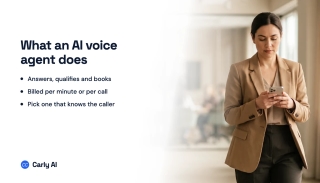
The quick answer: An AI voice agent for customer service answers your support line, resolves routine calls (order status, returns, billing questions, appointments, account updates) from your own policies and systems, and transfers the rest to a person with a summary. Helpdesk add-ons like Zendesk’s voice AI agents and Intercom’s Fin Voice bill roughly $1.50 to $2.00 per resolved call or outcome. Build-your-own platforms like Retell AI and Vapi bill per minute and need a developer. For a support team, the pick is Carly: it answers when your team can’t, knows the caller from your email and CRM, books callbacks on the right teammate’s real calendar and puts every call, text and email in one team inbox.
AI voice agents for customer service compared
US prices from each vendor’s own pricing page or help center, checked October 1 and 2, 2026.
| Option | Kind | Price | Best fit |
|---|---|---|---|
| Carly | Business-ready: calls, texts and email in one team inbox | Phone line priced on a short call. Free Zapier-style workflows; AI agents from $35/month | Support teams that want AI on the line when nobody can pick up, with callers recognized from email and CRM |
| Zendesk voice AI agents | Helpdesk add-on | $1.50 per verified resolution past your plan allowance ($2.00 pay-as-you-go), plus a $0.005/min AI connection charge, telephony minutes and call recording | Teams already on Zendesk Suite (from $55/agent/mo, billed annually) with Zendesk voice |
| Intercom Fin Voice | Helpdesk add-on | $1.99 per voice outcome, sold through sales | Intercom customers with a phone system Fin can forward from (Twilio, Aircall, RingCentral and others) |
| Smith.ai AI Receptionist | Business-ready | Free for 25 calls/mo ($3 per call after). Pro $150/mo for 75 calls ($2.50 per call after) | Low call volume, priced per call |
| Retell AI | Build your own | $0.07 to $0.31/min, depending on model and voice | Teams with a developer to wire in the helpdesk, order system and transfers |
| Vapi | Build your own | $0.05/min hosting, plus transcription, model, voice and phone at cost (Vapi’s calculator: $82 to $129 for 1,000 minutes) | Same |
| Bland | Build your own | $0.14/min | Same |
Gorgias and Freshdesk aren’t in the table because neither puts an AI agent on the call today. Gorgias Voice is a phone line for human agents, and Freshworks’ AI agent builder makes chat and email agents, with phone support in a separate product. For how voice agents work under the hood and the wider price list, see our AI voice agent guide.
What customers call support about, and where the AI should stop
Gartner predicts that by 2029, agentic AI will resolve 80% of common customer service issues without a person, cutting operating costs by 30% (March 2025). The word doing the work there is “common.” Here’s what common looks like on a support line.
| Call | What a good voice agent does | Hand to a person when |
|---|---|---|
| ”Where’s my order?” | Finds the order from the caller’s number or order number, reads the status, texts the tracking link | It shows delivered and the customer says it never arrived |
| Returns and exchanges | Checks the order date against your return window, explains the steps, texts the instructions | The customer wants an exception to the policy |
| Billing questions | Explains a charge in plain words and resends the receipt | It’s a refund, a dispute, or anything that needs a card number |
| Appointments | Books, moves or cancels on the real calendar while the caller is on the line | The slot needs judgment: a long job, a key account, an overbooked day |
| Account changes | Updates an address or contact detail after checking the caller against your records | Ownership, passwords, or anything your rules say a person must verify |
Two rules hold for all five. The agent answers from your written policies, not from what a language model thinks a return policy usually says. And it never takes a card number by voice: it texts a secure payment link or hands off.
The handoff is what customers judge
In a Gartner survey of 5,728 customers (published July 2024), 64% said they’d prefer companies didn’t use AI for customer service, and 53% would consider switching to a competitor over it. Their top concern wasn’t wrong answers. It was that AI would make it harder to reach a person. Salesforce’s State of Service research adds that 66% of customers often have to repeat or re-explain information to different representatives.
So design the handoff before the greeting:
- A person is one sentence away. “Can I talk to someone?” triggers a transfer, not a second attempt at the answer.
- The teammate gets the context before saying hello: who called, what they asked, what the agent already tried, and the order or account it found.
- No dead end when nobody’s free. The agent books a callback at a real time on the right teammate’s calendar instead of promising that someone will get back to them.
- The call and the follow-up share one history. If the customer texts later, it lands on the same thread, in the same inbox.
After hours on the support line
Most teams start a voice agent here, because the alternative is voicemail. At 9pm the agent has three jobs:
- Resolve what your policy already covers: order status, return steps, store hours, how to reset a device.
- Escalate what can’t wait. When a customer is locked out of an account they need tonight, the agent texts the on-call teammate a summary the moment the call ends.
- Book everything else into tomorrow, so the morning team starts with a list of callbacks, not a voicemail box.
Check what after-hours routing costs on your helpdesk. On Zendesk, Suite Team includes telephony, but business hours, after-hours routing and phone menus start at Suite Professional, $115 per agent a month billed annually. Our after-hours answering service guide compares the other options by cost.
How Carly handles a support call
Carly is an AI assistant for businesses, and Carly for teams gives it your support line. Here’s a Thursday-evening call to Larkspur Outdoor, a five-person Shopify store selling camping gear.
- The team rings first. Calls ring Josh and Emily. When nobody picks up, Carly answers in Larkspur’s name. Or Larkspur lets Carly answer around the clock.
- Carly knows who’s calling. Claire’s number matches her CRM record and last week’s email about a tent order, so Carly starts with context instead of “can I get your name?”
- It answers from Larkspur’s own policies. The shipping page, return policy and FAQs are Carly’s source. Claire’s tent is inside the 30-day window, so Carly walks her through the return and texts the instructions from the same business number.
- It hands off when it should. Claire wants the refund sent to a different card, which Larkspur’s rules give to a person. Carly rings Emily, who’s on another call, so Carly books a callback on Emily’s real calendar for 10am while Claire is still on the line.
- Everything lands in one place. The transcript and summary go to the team inbox and Claire’s CRM record, next to her emails and texts. Emily reads it before she dials.
Calls, texts and email share one team inbox, one timeline per customer. Assign a conversation, leave internal comments, @mention a teammate. A teammate replying by hand pauses the AI on that thread. Your support@ address can go to an email agent with its own address.
Keep your helpdesk if it’s working. Carly connects to thousands of apps, Zendesk included, and workflows fire on call ended, call summarized, voicemail received and text received. So “open a Zendesk ticket from every call summary” or “text back every missed caller within seconds” is something you describe once in plain English.
Want the agent reading live order status from Shopify or your own order system mid-call, or running at contact-center volume? The Carly team scopes that with you, so book a call with the Carly team. They set up the number with you (the one customers already call, or a new one), and the phone line is priced on that call. Beyond the phone line, Carly has free Zapier-style workflows; AI agents from $35/month. Get started with Carly and load the answers to the questions your team hears every day.
How to measure an AI voice agent on your support line
Vendors bill on their own definition of success, so learn it before you trust their dashboard. Zendesk bills only verified resolutions, confirmed by an AI review of the transcript at hang-up. Fin Voice bills per voice outcome. Track these five yourself:
| Metric | How to count it | Watch for |
|---|---|---|
| Containment rate | Calls the AI finished with no transfer, divided by calls it answered | A caller who gives up and hangs up counts as “contained” |
| Repeat-call rate | Callers who ring back about the same issue within 7 days | The truest check on whether “resolved” meant resolved |
| CSAT | A one-question text survey after the call | Ask about the outcome, not the voice |
| Handle time after a transfer | Minutes a teammate spends on handed-off calls | Should drop once the summary arrives with the call |
| Missed calls | Calls that rang out or reached voicemail | Should fall close to zero in the first month |
With Carly, each call’s outcome (answered, no answer, voicemail), summary and transcript ride along on the workflow trigger, so one workflow can write every call to a Google Sheet or a data table you review on Fridays. For the survey itself, our CSAT survey guide has the questions and the formula.
Six tests to run before you buy
Run these from your own phone, before you sign.
- Call as an annoyed customer. Talk over it, give a wrong order number, change your mind mid-sentence. It should stop talking when you start and recover without restarting its script.
- Ask for a person in your first sentence. Time the transfer, then ask the teammate what they were told.
- Call from a number in your CRM. Does the agent know your name, your last email, your open order?
- Change a policy and call again. Edit the return window in its knowledge source. The next call should quote the new one.
- Listen to the first ten seconds. Since August 2, 2026, Article 50 of the EU AI Act requires AI systems that talk to people, voice agents included, to tell them they’re dealing with AI unless it’s obvious, with fines up to €15 million or 3% of worldwide turnover. Recording has its own rules. US federal law allows it with one party’s consent, but California, Florida, Pennsylvania, Washington and a handful of other states require everyone on the call to agree, and with a caller in another state the safe move is everyone’s consent. One opening line covers both: “You’re speaking with Larkspur’s AI assistant, and this call is recorded.” This isn’t legal advice.
- Ask it to call you back. A callback the customer asked for is the low-risk kind. AI voices count as artificial voices under the TCPA, so read our AI outbound calling guide before the agent dials anyone who didn’t ask.
FAQ
What is an AI voice agent for customer service?
Software that answers your support line in a natural voice, resolves routine requests from your policies and systems, and transfers the rest to a person with a summary. Carly does this on your own business number and files every call next to the customer’s emails and texts.
Will customers mind talking to an AI on the phone?
Many will if it blocks them from a person: that was the top concern in Gartner’s survey of 5,728 customers. Start the agent on overflow and after hours, make “a person, please” work on the first try, and say up front that it’s an AI.
Can an AI voice agent replace a support team?
It can take the routine calls and the ones your team misses. Refunds outside policy, upset customers and anything that needs judgment belong with a person, so the useful setup is AI on the first answer with handoffs into the inbox your team already works.
How much does an AI voice agent for customer service cost?
Helpdesk add-ons bill per resolution or outcome: Zendesk charges $1.50 to $2.00 per verified resolution past your allowance plus per-minute charges, and Intercom’s Fin Voice is $1.99 per voice outcome through sales. Build-your-own platforms run about $0.07 to $0.31 a minute plus a developer. Carly’s phone line is priced on a short call, so book a call with the Carly team to scope it to your volume.
Can I keep Zendesk or Intercom and add an AI voice agent?
Yes. Both sell their own voice agents (see the table above). Or keep your helpdesk for tickets and chat and put Carly on the phone line and texts, with a workflow that turns each call summary into a ticket. Get started with Carly and test it with a call from your own phone.
Ready to automate your busywork?
Carly schedules, researches, and briefs you—so you can focus on what matters.
See what people say
"Before Carly, I relied on a Calendly link, but the whole process felt impersonal and not very professional. Carly changed that by handling all the back-and-forth, so I'm no longer stuck in endless email threads trying to line up schedules.
Now Carly reaches out to candidates, shares my real-time availability, lets them pick a slot, then sends a Zoom link and drops it straight into my calendar. She sends reminders to both of us before each call, which has significantly reduced no-shows and last-minute confusion.
On top of scheduling, Carly acts like a full executive assistant, sending me my schedule the night before so I can prepare for each call. It reminds me of the old x.ai assistant, but Carly is noticeably smarter, faster, and better suited to my healthcare recruitment business."