Connect Multiple OneDrive Accounts to Gemini Spark
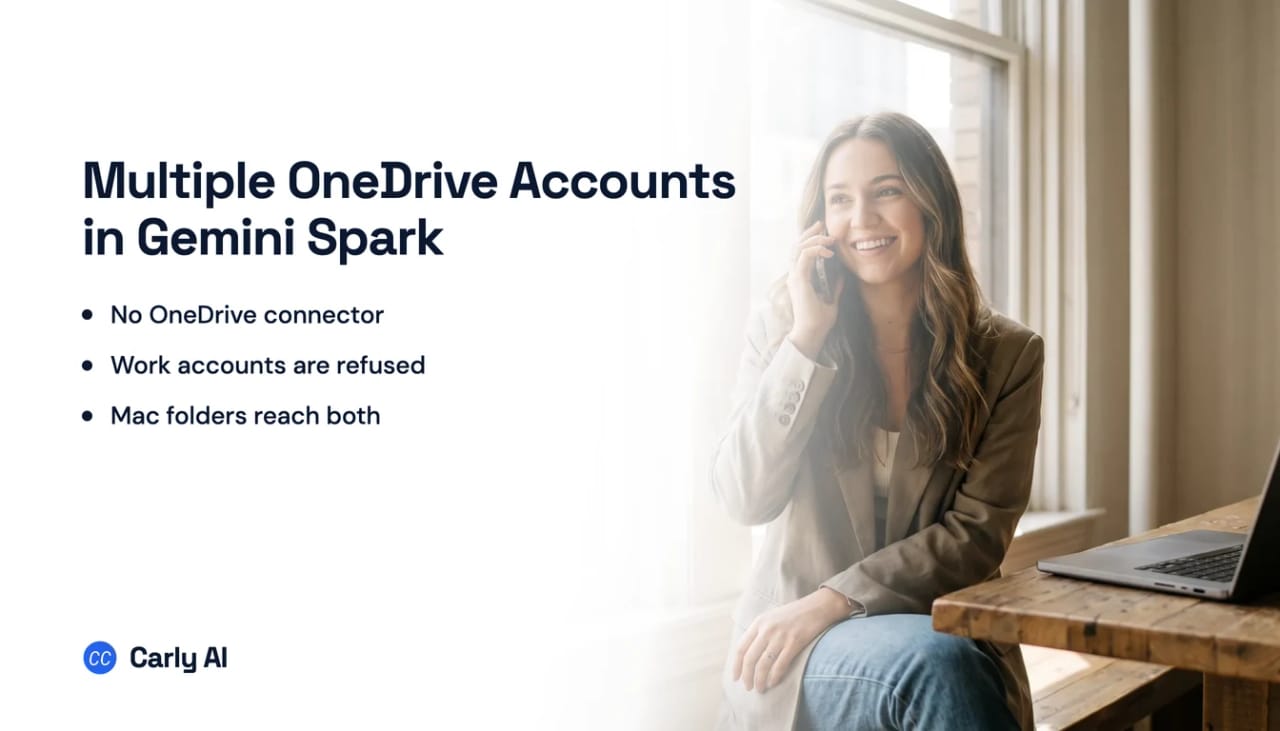
Gemini Spark has no Microsoft connector, so there is no first OneDrive account to add on Google’s side, and Carly is what puts several of them in one session. A Google-built OneDrive connector exists in Gemini Enterprise, and it runs on a work account while Spark runs on a personal one, so the two exclude each other structurally. Connect all your Microsoft accounts to Carly, add Carly to Spark as a custom app, and a personal drive and two work drives answer the same question. Carly holds your Google Drive accounts, and every mailbox and calendar on both sides, in the same place.
1. Add your OneDrive accounts to Carly
- Sign in at carlyassistant.com.
- Open carlyassistant.com/integrations.
- Find OneDrive, click Connect, and authorize the account.
- Click Connect again for the next one, and keep going for as many accounts as you want.
No Entra app registration, no tenant ID, no Google Cloud project, and no sync client.
Carly connects to thousands of apps, so while you are on that page you can add your inboxes, calendars, CRM, and anything else you want Gemini Spark to reach through the same connector.
2. Add Carly to Spark as a custom app
Custom apps are Spark’s supported channel for reaching a server rather than a folder.
- Go to gemini.google.com on a computer.
- Open Settings & help → Connected Apps. If it is not there, look under Personal Intelligence, then Connected Apps.
- Under Custom apps for Spark, click Add a custom app.
- Enter
https://carlyassistant.com/mcp/. - If prompted, open Show more under Advanced features to enter credentials.
- Click Next and follow the on-screen instructions.
You work with Carly directly from step 2. The OneDrive accounts are connected and usable the moment you authorize them. Adding Carly to Gemini Spark is what puts them inside a Gemini Spark chat, and that step is optional. Most readers stop here.
Google’s requirements: eligible for Spark, 18 or over and in the US, signed in with a personal Google Account since the feature “isn’t available if you sign in with a work or school Google Account,” English only, and Keep Activity on, because “Gemini can’t connect to custom apps when this setting is off.” Adding one works only in the Gemini web app, though a connected app is then usable in the mobile app too; custom apps never appear in the Mac app. Support has rolled out unevenly across Spark’s surfaces and tiers, so check your plan and platform against Google’s availability documentation if the option is missing.
Google’s own tip: type @ and select the custom app to be sure Spark uses it. It also notes that Gemini requires manual confirmation for any write action, and that it does not control or secure third-party MCP servers. Carly’s actions here are the OneDrive operations you authorized per account, revocable at carlyassistant.com/integrations.
MCP is only starting to learn how to start things. ChatGPT can now kick off an automation from an MCP event, but it is building on a proposal: the protocol's own Triggers and Events working group still lists the specification as ideating, and every app has to ship its own event support. OpenAI's docs still list only three apps whose events can start a task: Gmail, Slack and GitHub. Carly workflows start on their own when an email comes in, a meeting gets booked, a lead changes stage in the CRM or a row lands in a spreadsheet, and Carly can keep an eye on any app with an API.
So use the connector for reach and Carly’s own workflows for reaction, which is also what covers you where Spark’s US, English and personal-account gates rule you out.
What one Spark session can do afterwards
- Search a personal OneDrive and a work OneDrive in one request.
- Reconcile an expenses sheet in one account against a log in another.
- Save, rename or file a document in any of your accounts.
- Hold several work accounts at once, with no sync client in the middle.
- Start when the file arrives, rather than at the next scheduled run.
What the native path covers
| What you have | Reachable in one Spark session |
|---|---|
| One work or school Microsoft tenant | Only through Carly |
| A personal @outlook.com drive | Only through Carly |
| Two work tenants at once | Only through Carly |
| The Gemini Enterprise OneDrive connector | Not from Spark, which rejects work Google Accounts |
| Any OneDrive folder synced on a Mac | Partly, as local files through Connected folders |
Where Spark’s own OneDrive reach stops
Microsoft appears nowhere in Spark’s connected apps
Google publishes two connected-apps lists, one for personal Google Accounts and one for work or school accounts. Neither carries a single Microsoft entry: no OneDrive, no SharePoint, no Outlook, no Teams. Dropbox is on the list, which is what makes the omission legible. Competing consumer storage got in and Microsoft did not. Spark’s changelog says the same: the connected apps added in July 2026 were Canva, Instacart and OpenTable, then Dropbox and Zillow. No Microsoft product has ever appeared, so the native answer is not “one account only.” It is no connector.
The Gemini Enterprise connector is real, and Spark cannot reach it
Worth chasing all the way down, because the connector exists and is genuinely self-serve. Google’s Help Center for Gemini Enterprise Business edition lists it as “Microsoft: Learn, OneDrive, Outlook (Email and Calendar), SharePoint, and Teams”, on a page last updated in June 2026. The path is Settings and help, then your Team, then Manage team, then a switch in the Connectors view, after which each person authenticates their own Microsoft account. No Entra app registration, no tenant ID, no Google Cloud project.
Then it closes. Business edition runs on a work account, and Spark refuses work or school Google Accounts. Google documents no bridge: the word Spark appears nowhere in the Business edition connectors documentation, or in its release notes through mid-August 2026. Date-stamp that, because it is the piece most likely to move. Google hedges the personal-account restriction with “for now” three separate times.
Spark’s own gates are four: 18 or over, a personal Google Account, a Google AI Pro or Ultra subscription, and Keep Activity on. It runs in the Gemini mobile app, the Gemini app on Mac and the Gemini web app, with no Windows client, and is unavailable in the European Economic Area, Nigeria, Switzerland and the United Kingdom. One vendor contradiction is worth reporting rather than resolving: Google’s marketing page still says Spark is “currently available for Google AI Ultra subscribers over 18 in select countries as well as select business users,” while the help centre says Pro or Ultra and rules out work accounts. The help centre is the more specific page.
Connected folders on Mac is a local file feature, not an integration
Spark on Mac has a Connected folders feature, and a OneDrive sync folder is a folder in Finder, so pointing one at the other does reach OneDrive content. Google’s wording: “Gemini can only view files or directories that you specifically add to the Connected folders toolbar,” and what it can then do is “analyze, edit, rename, or re-organize” them. Microsoft’s sync documentation confirms you can hold “multiple work or school accounts, but only one Personal OneDrive account”, each appearing separately in Finder.
Be strict about what that is, because it is easy to oversell. Google never writes the word OneDrive on that page, so “a OneDrive sync folder counts as one of Google’s public cloud drives” is an inference. The warning attached to exactly this case is Google’s own: “Be careful when adding public cloud drives to your Connected Folders. Gemini will be able to access, edit, share, and delete its files.” Google adds that data shared into that drive becomes visible to anyone else with access. The route also needs the Mac awake, which sits badly against Google’s marketing claim that Spark works “24/7, even if your phone and laptop are turned off,” and custom apps cannot be added in the Mac app at all, so the two routes never share a surface. Start with a narrow subfolder, never a whole drive.
Spark’s three triggers, and the one thing none of them watch
Google’s documentation names exactly three schedule types: time-based runs, Gmail monitors that run when you receive an email matching a Gmail filter, and topic monitors watching news, finance, sports and local events. Not one of them watches a file. There is no OneDrive monitor, no Drive monitor, and no storage monitor of any kind, not even for Google’s own Drive. Google also cautions that “monitors are still not ideal for tracking fast-moving data or performing time-critical tasks.”
Concretely: a client uploads a signed order form to a shared OneDrive folder at 11am, your Spark task is a daily 8am schedule, so it notices twenty one hours later. An hourly schedule turns that into polling that mostly finds nothing.
What each route can do to a file
| Route | Search and read | Create folder | Upload | Copy | Move or rename | Edit in place | Delete |
|---|---|---|---|---|---|---|---|
| Spark native OneDrive | No connector | n/a | n/a | n/a | n/a | n/a | n/a |
| Gemini Enterprise OneDrive connector | Yes | Yes | Yes, 50 MB cap | Yes | No documented action | No documented action | No documented action |
| Gemini Enterprise SharePoint connector | Yes | Yes | Yes | not listed | Yes, rename and move | Check in and out | No documented action |
| Spark Connected folders on Mac | Yes | Yes | local files | Yes | Yes | Yes | Yes |
Two things fall out of that. The official OneDrive connector is narrower than the SharePoint connector beside it in the same product, an odd asymmetry to discover after buying. And Connected folders has a broader verb set on OneDrive content than Google’s own OneDrive connector, which is exactly why it should be treated carefully rather than trusted: Google has never committed to it behaving as a OneDrive integration.
Gemini Spark versus Carly on OneDrive
| Need | Gemini Spark | Carly |
|---|---|---|
| A OneDrive connector | None exists | Yes |
| Work and personal Microsoft accounts at once | Only as synced Mac folders | Yes, all of them |
| Work from a work or school Google Account | No, Spark refuses it | Yes |
| Available in the UK, EEA, Switzerland | No | Yes |
| Act when a file lands in a folder | No, clock and Gmail only | Yes |
| Work without the Mac awake | Not for folder work | Yes |
Carly connects all your Microsoft accounts at once, so a personal drive and two work drives sit side by side with no sync client in the middle, and it works from a Google account, a Microsoft account, or neither. It fires when the file arrives rather than at the next scheduled run, which is what the order-form example above actually needs.
Free Zapier-style workflows; AI agents from $35/month. Connect it at carlyassistant.com/integrations, or start with OneDrive.
Quick fixes
| Problem | Fix |
|---|---|
| No OneDrive in Spark’s connected apps | Expected, no Microsoft product has ever been on that list |
| Custom apps option missing in the Mac app | Custom apps can only be added in the Gemini web app, and never appear in the Mac app |
| Custom app connection refuses to complete | Keep Activity has to be on, and the feature is US and English only |
| Spark refuses your Google account | Work and school accounts are not eligible; connect the drives at carlyassistant.com/integrations instead |
| Two business accounts will not both sync on macOS | Microsoft fails setup when two organizations share a display name, rename one first |
| Nothing fires when a file lands | Spark has no storage trigger of any kind, so put the recurring work in a Carly workflow |
Frequently asked questions
Does Gemini Spark connect to OneDrive?
Not natively. Google’s connected-apps lists for personal and for work or school Google Accounts carry no Microsoft entry at all, and Spark’s changelog has never added one. Dropbox is on the list, so third-party storage is in scope. Carly reaches OneDrive from Spark as a custom app.
Can I use the Gemini Enterprise OneDrive connector from Spark?
No. The connector is real and Business edition is self-serve, but it runs on a work account and Spark is documented as unavailable on a work or school Google Account. Google publishes no bridge.
How many OneDrive accounts can Spark reach through Connected folders?
As many as the Mac can sync, which Microsoft documents as several work or school accounts plus one personal account. Google never names OneDrive on the Connected folders page, so treat this as an inference to verify on a test folder, and note that it needs the Mac awake.
Can Spark delete a OneDrive file?
Through Connected folders, yes, which is worth reading twice. Google warns that a connected cloud drive lets Gemini access, edit, share and delete its files, and says Gemini is designed to ask permission before permanent deletion or sharing. The Gemini Enterprise connector publishes no delete action at all.
Does Spark run a task when a OneDrive file changes?
No. Google names three schedule types: time-based, Gmail monitors and topic monitors. None of them watches storage, including Google Drive, so a file arriving surfaces at the next scheduled run.
Related: Multiple OneDrive accounts in Gemini · Multiple Outlook accounts in Gemini Spark · Multiple Google Calendars in Gemini Spark · What is Gemini Spark · Best AI assistants for multiple Microsoft accounts · OneDrive integration
Ready to automate your busywork?
Carly schedules, researches, and briefs you—so you can focus on what matters.
See what people say
"Before Carly, I relied on a Calendly link, but the whole process felt impersonal and not very professional. Carly changed that by handling all the back-and-forth, so I'm no longer stuck in endless email threads trying to line up schedules.
Now Carly reaches out to candidates, shares my real-time availability, lets them pick a slot, then sends a Zoom link and drops it straight into my calendar. She sends reminders to both of us before each call, which has significantly reduced no-shows and last-minute confusion.
On top of scheduling, Carly acts like a full executive assistant, sending me my schedule the night before so I can prepare for each call. It reminds me of the old x.ai assistant, but Carly is noticeably smarter, faster, and better suited to my healthcare recruitment business."