Answering Service for Plumbers: Options and Costs (2026)
A pipe splits inside a garage wall on the first hard freeze, a sewer line backs up into a finished basement on Sunday night, and a homeowner with a cold shower dials three plumbers off Google at 9pm.
Each of those calls is a job for whoever answers. Voicemail usually hands it to the next name on the list.
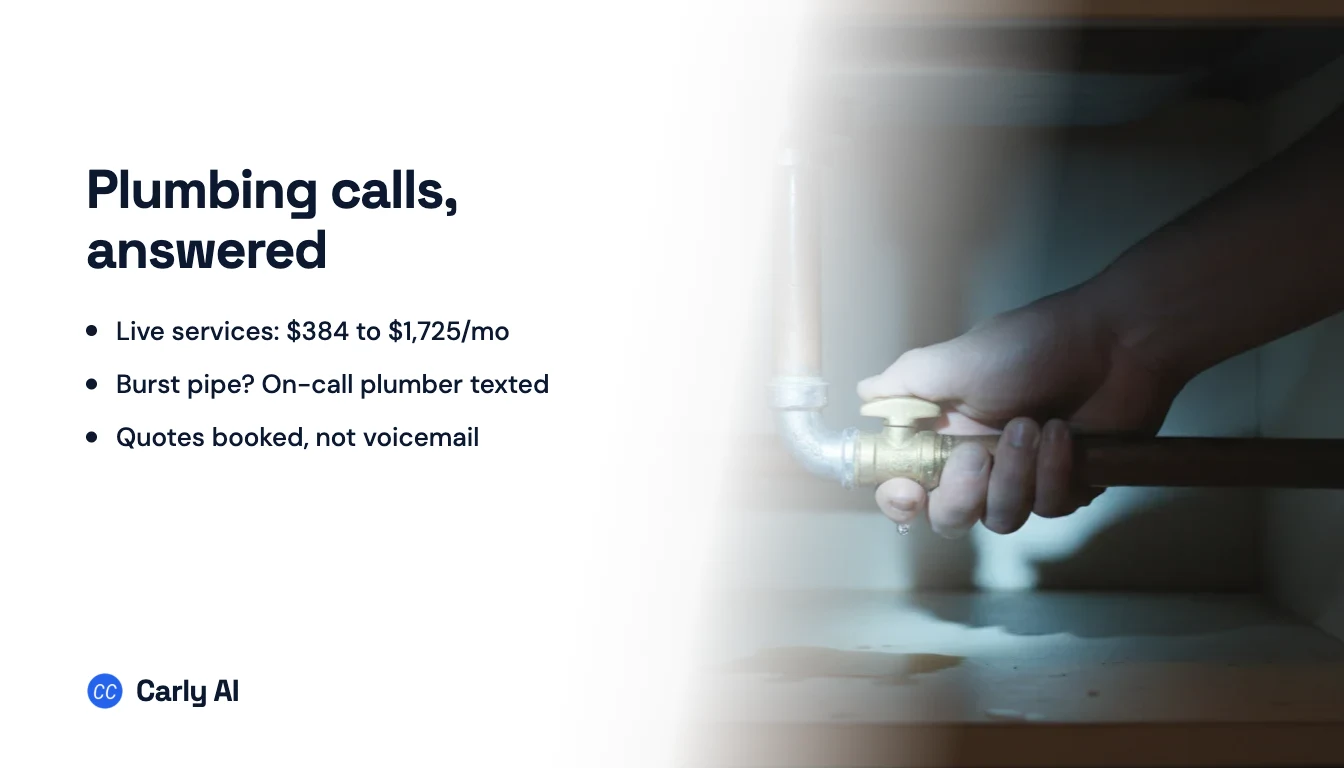
The quick answer: An answering service for plumbers takes the calls your shop can’t: after close, on weekends, and at 10am when every plumber is under a sink and the office line is already lit up. Plumbers usually pick one of four: an on-call phone that rotates between your plumbers (free, until whoever has it is mid-job with wet hands), the receptionist add-on in your field service software ($29 a month on Jobber; Housecall Pro and ServiceTitan don’t publish a price), a live answering service like PATLive, MAP Communications or Ruby (about $384 to $1,725 a month at 120 calls), or an AI answering service. Carly is the pick: it answers on your shop’s own number any time your team can’t, sends the on-call plumber a text summary the moment a burst-pipe caller hangs up, books drain jobs and water heater estimates onto real calendars and leaves the office one clean inbox to start the day.
Plumbing answering service pricing at 120 calls a month
These are each vendor’s published US monthly rates as of October 7, 2026. The estimate assumes a residential shop with three to five plumbers that sends 120 calls a month to the service (about 70 after close and on weekends, 50 during the day when the office line is tied up), each billed at 2.5 minutes, so 300 minutes. We priced calls short because most of these are quick: a name, an address, what’s leaking and whether the water is off.
| Option | Who picks up | Billed by | Our estimate: 120 calls, 300 min |
|---|---|---|---|
| Carly | AI on your shop’s number, after your team | Scoped to your call volume | Set on a short call |
| On-call phone rotation | Whichever plumber has it this week | Nothing | $0, paid for in missed calls and lost sleep |
| Jobber Receptionist | AI built into Jobber | Monthly add-on | $29 on top of any Jobber plan; call limits aren’t listed |
| Housecall Pro CSR AI, ServiceTitan AI Virtual Agent, Service Fusion ServiceCall.ai | AI built into that software | Not published | Ask for a quote |
| Quo Sona | AI built into the Quo phone system | Per call | $62 ($49 for 100 calls + 20 at $0.65), plus Quo seats from $19 a user |
| Rosie | AI | Minutes in plan | $149 (Scale plan, 1,000 min; the $49 plan stops at 250) |
| Smith.ai AI Receptionist | AI first, human operators on standby | Per call | $262.50 ($150 for 75 calls + 45 at $2.50) |
| Specialty Answering Service | Humans | Per minute, billed by the second | $384.20 ($269 for 220 min + 80 at $1.44) |
| MAP Communications | Humans | Per minute | $403 ($339 for 250 min + 50 at $1.28) |
| Sameday | AI built for home services | Minutes in plan, from 500 | $449 after hours only, $789 to answer every call |
| PATLive | Humans only | Per minute | $479 (300-minute plan) |
| Abby Connect | Humans, AI or both | Abby Minute; AI time counts half | About $494 all AI, $899 all human |
| Smith.ai live receptionists | Humans | Per call | $1,125 ($810 for 90 calls + 30 at $10.50), before add-ons |
| Ruby | Humans | Per minute | $1,725 (500-minute plan), or $720 for 200 min plus 100 at an unpublished overage rate |
| Avoca | AI for HVAC and plumbing shops | Quote only | Quote only |
AnswerConnect and AnswerForce keep their prices behind a sign-up form.
Human answering runs $384 to $1,725 at this volume, general AI from $62 (plus Quo seats) to about $494. Sameday, which builds for home services and counts several plumbing shops among its case studies, is $449 for after-hours calls or $789 for all of them. For offices outside the trades, our AI answering service guide compares general-purpose options.
Short calls change the math
At 2.5 minutes a call, Specialty Answering Service, MAP and PATLive work out to $3.20 to $3.99 per call. Smith.ai’s live plan bills by the call and comes to $9.38 each, before $1.50 per booked appointment. Per-minute bills climb with call length, though: at 4 minutes a call, those three plans bill $633 to $759, and Smith.ai’s per-call live plan only becomes the cheaper human option once calls average 6 to 7 minutes. Per-call AI like Quo’s Sona costs the same whether a call runs one minute or ten. Check last month’s average call length before you choose.
Then set the bill next to one job: if a single water heater replacement a month comes from calls that used to reach voicemail, which rows does it pay for?
What each option does with a sewer backup at 11pm
| Sewage coming up a basement drain, 11pm | Gas smell at the water heater | Water heater replacement quote, 9pm | What the office sees at 7:30am | |
|---|---|---|---|---|
| On-call phone | Reaches the plumber holding it, if they hear it | Depends on that plumber knowing the script | Voicemail, while the caller keeps dialing | Whatever got scribbled on a notepad |
| Live answering service | Operator pages or patches through the on-call plumber if your script says to | Sent to the gas company or 911 if your script says so | Takes a message; some book an appointment | Emailed messages or a vendor portal to check |
| Field service software’s AI | Logs a job request or forwards the call to a phone you pick | Whatever you configured | Booked on that platform’s schedule | Requests and call logs inside that platform |
| Basic AI answering | Takes the address and the problem | Takes a message | Takes a message | Transcripts to read and call back |
| Carly | Caller told to stop running water, on-call plumber texted the summary when the call ends | Sent outside to call the gas company or 911, no booking, owner and on-call plumber get a text | Questions answered, estimate booked on the estimator’s calendar, confirmation texted | One shared inbox holding each call’s summary, every text and every booking |
The homeowner on that first call is watching a bill grow. Triple-I, using ISO data, reports that homeowners claims for water damage and freezing averaged $15,400 each from 2019 to 2023, with about 1.5 claims per 100 insured homes a year. Maine’s emergency management agency notes that a 1/8-inch crack in a pipe can release up to 250 gallons of water a day and tells households to learn how to shut off their water before a pipe bursts. Whatever answers your phone should know that too.
What a plumbing answering setup has to get right
1. Put every call in one of four lanes
Have the setup ask your triage questions (“Is water coming out right now?”, “Is the main shut off?”, “Gas or electric water heater?”) and sort each answer into a lane:
- Send a plumber tonight: an active leak or burst pipe, sewage coming up a drain, no water to the house, a water heater leaking from the tank, a frozen pipe that has split.
- Get out, then call the gas company or 911, book nothing: a rotten-egg smell near a gas water heater or anywhere in the house.
- Book into tomorrow: a slow drain, a running toilet, a dripping faucet, one clogged toilet in a house with two. The caller should hang up holding a time on a real calendar, not a promised callback.
- Sales lead: a water heater replacement, a tankless conversion, a repipe, a sewer line replacement, a second opinion on another plumber’s quote.
A dead water heater on a January morning can go either way, so write down what moves it up a lane, like a newborn in the house.
2. Get the water off before anything else
The fastest damage control is the caller’s own hand on a valve. The script should ask whether they know where the main shutoff is (a basement wall, near the meter, in a crawlspace or at the curb), walk them to it and confirm it’s closed. On a sewer backup, they stop flushing and running water. On a frozen pipe, they never thaw it with a torch or open flame, which Maine’s guidance also warns against.
3. Page the on-call plumber with a job, not just a number
The alert should carry the address, what’s leaking, whether the water is off, whether the basement is finished and a callback number, so the plumber can judge tonight versus 7am before dialing. Alerts can cost extra: Smith.ai adds $0.50 each time its live receptionists text or Slack you about a transfer, Specialty Answering Service bills $0.10 a minute to patch a caller through, and every PATLive plan includes emergency dispatch.
4. Win the 9pm comparison shopper
Homeowners pricing a water heater or a repipe call several plumbers from the same search. In a study of 1.25 million sales leads that Harvard Business Review wrote about, companies that tried to contact a lead within an hour were nearly seven times as likely to qualify it as those that tried even an hour later. A 9pm call returned at 8am has waited 11 hours. The win is the estimate booked while the caller is still on the line.
5. Know your landlord and property manager accounts
A property manager with 40 rentals calls about a different address every week. The setup should recognize the account by phone number, collect the tenant’s contact and access details and stay inside the account’s not-to-exceed amount, with all of it waiting for the office at 7:30am.
How Carly answers a plumbing shop’s phones
With Carly for teams, an AI voice agent and a text agent work the line your customers already dial. It works on a Twilio number you already have, or the Carly team gets you a new one during a short call. Let it take all calls or only the ones nobody grabs, so one setup covers the 10am overflow and the 11pm emergency, and every missed caller gets a text back.
Here is the first hard freeze of the winter at Brennan Plumbing & Drain, a four-plumber shop owned by Dave. Kevin has the on-call phone, Jessica runs the office and Mark handles estimates.
Monday, 9:05pm, a shopper. Chris Walker has no hot water, a 14-year-old tank and a search page full of plumbers. Carly picks up as Brennan, answers his tank-versus-tankless questions, asks Dave’s qualifying questions (gas or electric, tank size, where it sits) and books Mark at his house for 8am. The confirmation text comes from Brennan’s own number while the other shops are still holding his voicemail.
Monday, 11:20pm, a split pipe. Linda Parker calls with water spraying from a garage wall. Carly walks her to the main shutoff by the meter, confirms the water has stopped and files it as an emergency. When she hangs up, the “call summarized” trigger runs the one workflow Dave typed out in plain English: emergency calls go to Kevin by text, with the summary and the caller’s number. Kevin reads “Linda Parker, 42 Ridge Rd, pipe split in garage wall after the freeze, main shut off, wants someone tonight” and calls her back within minutes.
Tuesday, 5:50am, a gas smell. Paul Henderson went down to check his water heater and smells gas. Nothing gets booked. Carly tells him to take everyone outside without flipping a light switch, then phone the gas company or 911, and Kevin and Dave both get a text about it.
Tuesday, 7:25am, overflow. Jessica is on one line when Diane Foster from Northgate Rentals calls about a backed-up kitchen drain at a rental. Carly recognizes Northgate from the CRM, takes the tenant’s name and hours, books the first afternoon slot and texts Diane the confirmation.
Tuesday, 7:40am, the inbox. Jessica’s morning starts in one shared inbox: the night’s calls, texts and voicemails, each summarized on the customer’s timeline. Kevin’s note on Linda’s thread says three feet of copper went in and her water was back on by 1am. If the shop runs Jobber, Housecall Pro, ServiceTitan or Service Fusion, the same workflow can open the job there too, since each lets customers use its API. Carly connects to thousands of apps, saves every caller in its built-in CRM and steps back from any thread Jessica answers herself.
The setup, done once
- Hours and handoffs. Every call, after hours only, or anything that rings out. Anyone who wants a human gets put through to the right plumber via ring groups, and callers can speak English or Spanish.
- Its instructions. Your four lanes, the shutoff coaching, the gas script, service area, trip and diagnostic fees, and which property managers have accounts.
- Calendars. Plumbers’ calendars for repairs and drain work, the estimator’s calendar for replacements and repipes.
- Triggers. “Call summarized” is what texts Kevin, while “text received” and “voicemail received” make sure a 2am text about a sewer backup reaches him too. The full trigger list is on Carly’s workflows page.
- A night-time test. Call from your cell after dark, play Linda and read what Kevin would get. Here’s how to test an AI receptionist by calling it yourself.
Rather work from a chat? Add Carly Teams as a connector in ChatGPT (Plugins, then Add, then Create MCP App) or Claude (Customize, then Connectors) and type “answer our line after 5pm and whenever it rings out, use these emergency lanes and text Kevin on anything urgent.” The chat sets up both agents for you, and it can place calls and send texts to customers on the shop’s number. Our ChatGPT phone-call guide has a setup prompt to copy.
What Carly for teams costs depends on your call volume, and it’s worked out on a short call. Book a call with the Carly team and hear it take a split-pipe call and a water heater quote, or try Carly. Keeping your current service for now? Start with texting back every missed caller.
Before you sign: questions for any plumbing answering service
- Can you read me your gas-smell script? The right one gets the caller out of the house first and books nothing.
- Will your agents walk a caller to the shutoff? Ask them to role-play a split pipe.
- How is a minute counted? Specialty Answering Service counts every second, PATLive doesn’t bill after-call work, and Smith.ai’s AI plans let you remove up to a tenth of calls from the bill as spam.
- Is a 2am holiday call priced like a Tuesday afternoon? PATLive says it has no night, weekend or holiday fees, and Ruby includes nights, weekends and holidays with no coverage-period fees.
- What do Spanish-speaking callers hear? Every MAP plan includes English and Spanish, Rosie answers in both on every call, PATLive charges no bilingual fee, and Smith.ai’s dedicated Spanish line adds $1.00 a call.
More for plumbing shops: the best AI tools for plumbers, the HVAC answering service guide with these vendors priced for a bigger shop, and missed call statistics on what callers do when nobody answers.
FAQ
How much does an answering service for plumbers cost?
At 120 calls a month, our estimate for a shop with three to five plumbers, live answering costs about $384 (Specialty Answering Service) to $1,725 (Ruby’s 500-minute plan) at the rates vendors published on October 7, 2026. AI answering runs $62 (Quo’s Sona, plus Quo seats) to about $494 (Abby Connect, all AI), Sameday charges $449 to $789, and Jobber’s Receptionist is a $29 add-on. The Carly team prices Carly on a short call.
Is per-minute or per-call billing cheaper for a plumbing company?
Per-minute, when calls run a few minutes. At 2.5 minutes a call, live per-minute services cost $3.20 to $3.99 a call against $9.38 on Smith.ai’s per-call live plan, and per-call only wins among human services once calls average 6 to 7 minutes. Per-call AI costs the same however long the call runs.
Can an AI answering service handle plumbing emergencies?
Yes, once you write the lanes down. In Carly’s instructions you define what sends a plumber tonight and what the caller does first, and a workflow on the “call summarized” trigger sends the on-call plumber the details by text the moment the call ends. A gas smell gets the same answer from any service: get out and call the gas company or 911 from outside.
What’s the difference between a plumbing answering service and a virtual receptionist?
Coverage. An answering service catches what the office can’t: nights, weekends and overflow. A plumbing virtual receptionist covers the daytime desk as well, transferring calls and booking jobs. With an AI receptionist like Carly, you get both on the same number; the AI receptionist guide has more.
Does an answering service work with Jobber, Housecall Pro or ServiceTitan?
Each of those sells its own AI answering that works inside its platform: $29 a month on Jobber, unpublished on the other two. Live services mostly deliver messages by email, text or their own app. Carly texts and emails every summary and can open the job in your field service software too.
Do I have to change my shop’s phone number?
No. Carly works on the number you already advertise, through your own Twilio account, or the Carly team sets you up with a line on a short call. Most answering services instead have you forward calls from your number to theirs.
Ready to automate your busywork?
Carly schedules, researches, and briefs you—so you can focus on what matters.
See what people say
"Before Carly, I relied on a Calendly link, but the whole process felt impersonal and not very professional. Carly changed that by handling all the back-and-forth, so I'm no longer stuck in endless email threads trying to line up schedules.
Now Carly reaches out to candidates, shares my real-time availability, lets them pick a slot, then sends a Zoom link and drops it straight into my calendar. She sends reminders to both of us before each call, which has significantly reduced no-shows and last-minute confusion.
On top of scheduling, Carly acts like a full executive assistant, sending me my schedule the night before so I can prepare for each call. It reminds me of the old x.ai assistant, but Carly is noticeably smarter, faster, and better suited to my healthcare recruitment business."